For international students and young professionals applying across borders, few questions cause more confusion than the resume photo: “Should I include a professional headshot at the top of my CV, or will it hurt my chances?”
The answer depends entirely on the country you are applying in and the company's corporate structure. What is considered standard practice in one market can lead to instant disqualification in another. Here is the legal context, the regional conventions across major English-speaking hiring hubs, and how to format your application accordingly.
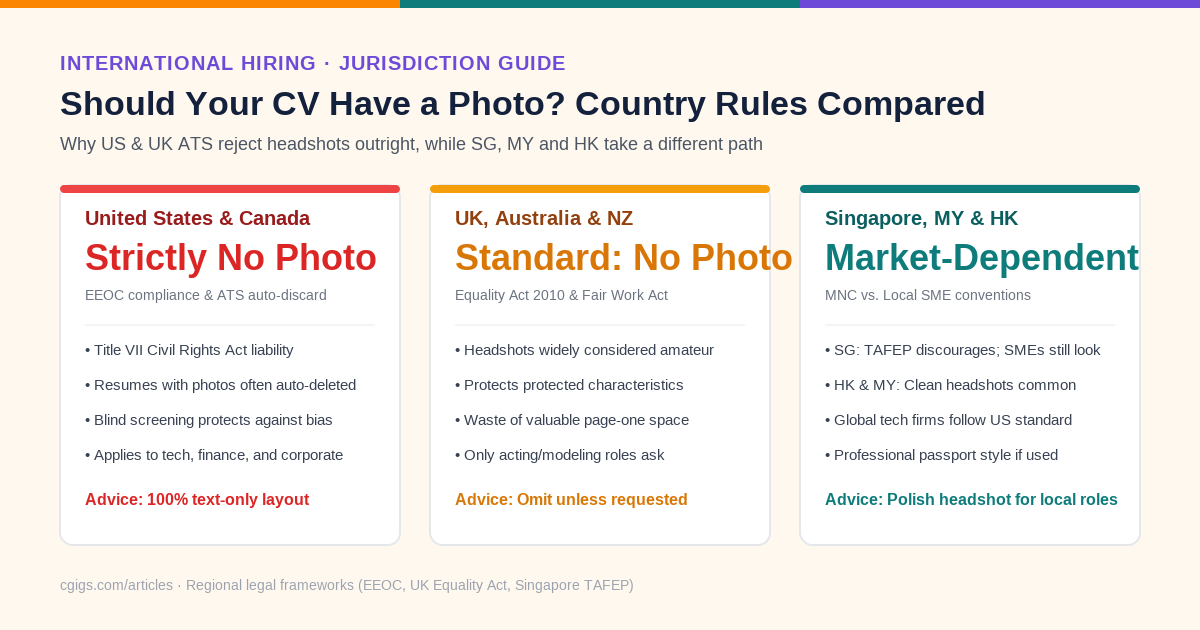
1. United States & Canada: Strictly No Photo
In the United States and Canada, resumes should never include a photograph. The reason is legal compliance and anti-bias liability under Title VII of the Civil Rights Act of 1964 and Equal Employment Opportunity Commission (EEOC) guidelines.
Federal and state laws prohibit employment discrimination on the basis of race, color, religion, sex, national origin, age (40 or older), or disability status. When an applicant attaches a headshot, it immediately exposes those protected characteristics to whoever opens the file. To protect themselves against discrimination lawsuits from rejected candidates, many corporate HR departments and Applicant Tracking Systems (ATS) enforce a strict blind-screening protocol: resumes containing photographs are automatically purged or shredded before a human hiring manager ever sees them.
The only exceptions in North America are specialized performance roles (acting, fashion modeling, broadcast television) where physical appearance is a bona fide occupational qualification (BFOQ). For all engineering, business, finance, and intern positions, keep your resume 100 percent text-based.
2. United Kingdom, Australia & New Zealand: No Photo
In the United Kingdom, recruitment practices are governed by the Equality Act 2010, which protects nine protected characteristics (including age, disability, gender reassignment, race, and religion). Similarly, Australia's Fair Work Act 2009 prohibits adverse action based on protected attributes.
British, Australian, and Kiwi hiring managers overwhelmingly view photos on standard CVs as unnecessary and unprofessional. A headshot wastes 15 percent to 20 percent of your top-of-page visual layout without adding any objective evidence about your technical ability or qualifications. Keep your CV text-focused.
3. Singapore, Malaysia & Hong Kong: The Nuanced Reality
In Southeast and East Asian business centres, conventions reflect a blend of regional traditions and global multinational practices:
Singapore: The Tripartite Alliance for Fair and Progressive Employment Practices (TAFEP) guidelines explicitly advise employers not to ask for photos, race, religion, gender, or age on job application forms. Global technology firms, investment banks, and multinational regional hubs adhere strictly to this guidance. However, local Singaporean small-to-medium enterprises (SMEs) and client-facing corporate service firms still frequently expect or appreciate a neat photo.
Hong Kong & Malaysia: Hong Kong's British institutional heritage and East Asian business customs coexist. While multinational banks and tech companies adhere to Western blind-screening rules, local commercial firms, retail managers, and corporate secretariats still view a professional passport-style photo as a courteous touch of presentation.
Summary Table: Where Does Your CV Go?
How to Handle Photos When Applying to Asian Hubs
If you are applying to local companies in Singapore, Malaysia, or Hong Kong that request or expect a photograph, follow these technical standards:
• Never use a selfie: Front-facing phone cameras distort facial proportions and convey an informal, amateur impression.
• Neutral, well-lit background: Use an off-white, light grey, or muted background with even lighting that eliminates harsh shadows.
• Standard business attire: A plain collared shirt, blouse, or blazer against a contrasting background.
• Crop from chest to crown: The head and shoulders should occupy roughly 70 percent to 80 percent of the photo square.
• Polish your shot: Our cgigs photo polish tool runs client-side background removal and portrait relighting directly in your browser, preparing an export-ready headshot tailored for Asian regional applications.
When in doubt, remember the universal rule: for the US, UK, Canada, and Australia, keep it 100 percent text; for Singapore, Malaysia, and Hong Kong, adapt your CV based on whether you are targeting an international multinational or a local firm.


