Every spring, small business owners and startup founders tell themselves the same story: “We have a backlog of projects, so let's hire a couple of college interns for the summer. It's cheap extra hands.”
If you treat an internship as cheap labor, you will almost certainly lose money and burn out your senior staff. Interns are not junior employees who hit the ground running; they are students learning how professional workplaces operate. Done poorly, they soak up senior hours without finishing projects. Done right, however, an internship program is the most cost-effective full-time hiring pipeline a small company can build. Here is the realistic line-by-line budget, the supervisor hours you must commit, and the math behind the conversion dividend.
1. The Direct Cash Budget (12-Week Term)
Unpaid internchips at for-profit companies are heavily restricted under the US Department of Labor's Fair Labor Standards Act (FLSA) Primary Beneficiary Test. Unless the student receives formal academic credit and does not displace regular staff, internships must be paid. According to the National Association of Colleges and Employers (NACE) 2026 Compensation Report, the national average hourly rate for a bachelor's degree-level intern is $23.35 per hour (up from $23.04 in 2024–2025).
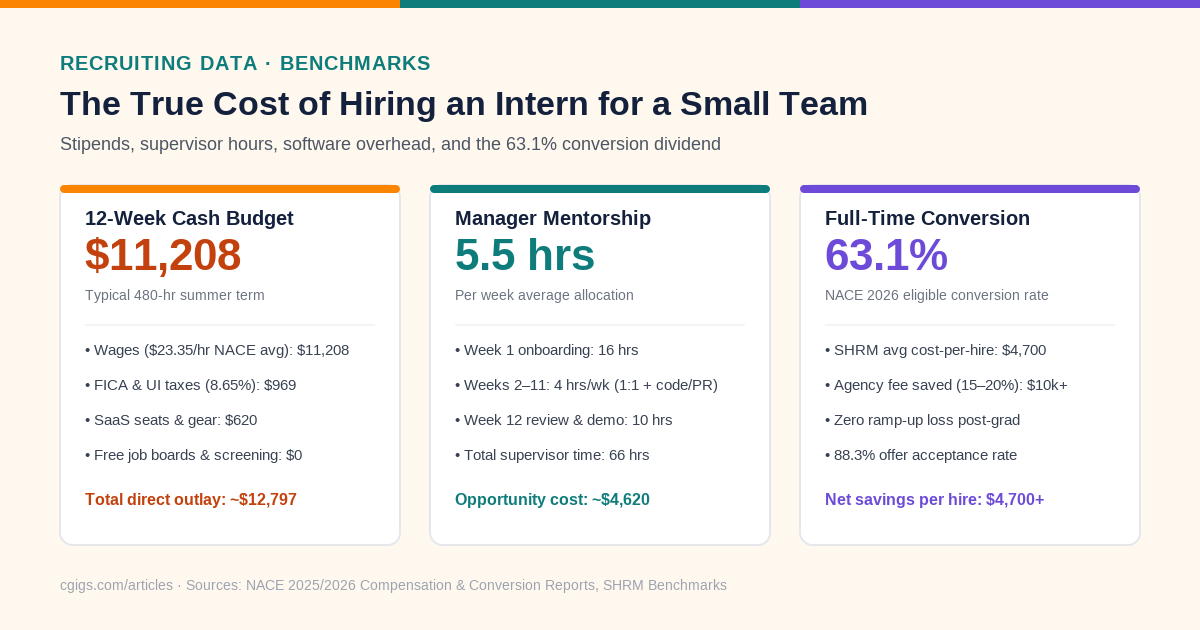
Here is what a standard 12-week full-time internship (40 hours per week, 480 total hours) actually costs in hard cash for a small team:
For technical roles (software engineering, data analysis), NACE benchmarks range from $26.00 to $32.00 per hour. For non-technical marketing, customer operations, or general business roles, typical rates range from $18.00 to $22.00 per hour. Budgeting approximately $12,000 to $13,500 in total cash outlay per intern is realistic for a modern small company.
2. The Hidden Cost: Senior Manager Time
Cash is rarely where small teams get surprised; senior time is. An intern cannot be handed a vague brief like “revamp our onboarding email sequence” and left alone. They require scoped tickets, clear acceptance criteria, daily unblocking, and thorough code or design reviews.
Across a 12-week program, your designated mentor or lead engineer will spend an average of 5.5 hours per week directly supporting the intern. Here is how those 66 total supervisor hours distribute over the summer:
If your senior engineer or operations lead bills or costs the company $70 per hour in salary and benefits, those 66 hours represent $4,620 in diverted internal capacity. If you hire two interns simultaneously under one mentor, total supervisor time only rises by about 35 percent (to roughly 90 hours total), because project onboarding and architecture reviews can be shared.
3. The 63.1 percent Conversion Dividend
If an intern costs ~$12,900 in cash and ~$4,600 in managerial time, why do small companies do it? The answer lies in conversion economics.
According to the Society for Human Resource Management (SHRM), the average direct cost-per-hire for a standard full-time employee across US businesses is $4,700. For technical or specialized roles, third-party recruiter fees routinely hit 15 percent to 20 percent of first-year base salary ($12,000 to $16,000 on an $80,000 junior developer salary).
More importantly, recruiting off open job boards carries a high failure rate: external hires take an average of 4 to 6 months to reach full productivity, and 15 percent to 25 percent of entry-level hires leave or are let go within their first year due to culture or skill mismatches.
NACE's 2026 data shows that among graduating interns eligible for full-time employment:
• 71.8 percent receive a full-time return offer from their host employer.
• 88.3 percent of those interns accept the offer.
• 63.1 percent of all eligible interns convert directly into permanent full-time hires.
An internship is a 480-hour working interview. You evaluate how the candidate communicates under deadlines, handles constructive feedback, and solves real problems. When they return after graduation, day-one onboarding is already finished: they already know your Git conventions, your customers, and your team culture.
How Small Recruiters Run This Without Big Software
Enterprise firms spend tens of thousands of dollars on enterprise applicant tracking systems (Workday, Greenhouse) and campus recruiting tours. Small businesses do not need that infrastructure:
• Collect applications directly: Post openings to regional college career offices and niche student job boards instead of paid aggregator networks.
• *Keep applicant resumes in one central bank: When student CVs arrive as PDFs or Word files, don't let them scatter across manager inboxes. Store candidates in your team's cgigs resume bank, where profiles can be tagged, searched, and invited to interview.
• Scope one standalone summer project: Give the intern a concrete goal that can be completed within 8 to 10 weeks (e.g., “build a self-hosted export tool for customers” or “audit and standardize our help centre articles”).
• Decide on return offers by Week 10: Don't wait until August. Make return offers before the student heads back to campus for their senior year.
When you budget for $13k in cash and 66 manager hours, an internship stops being a chaotic gamble and becomes the highest-ROI talent channel in your business.


