You took a semester off. Or a year. Maybe you were ill, maybe family needed you, maybe you travelled or just burned out. Now you're writing a graduate CV and that gap sits right there.
Good news: a study break is common, and the fix is small. One honest line, no medical detail, one fact about what you did, and a calm answer ready for interviews. This guide covers the wording, the legal side and examples you can copy.
What the data says (and what it doesn't)
There is no clean study on student leave of absence and hiring. What we can cite is one survey of US hiring managers about long employment gaps in general:
Read it with care. It is about employment gaps, not study breaks, and it comes from a CV-software company. But it shows a common attitude: most managers don't treat a gap as a dealbreaker. Your job is to make the gap short, clear and boring.
Chronology or skills-based format?
For a graduate, use a normal reverse-chronological CV. Here's why:
A skills-only layout hides dates, and readers notice. It can also confuse CV scanners. Keep dates in plain view and put the good stuff next to them.
How much to say: one line
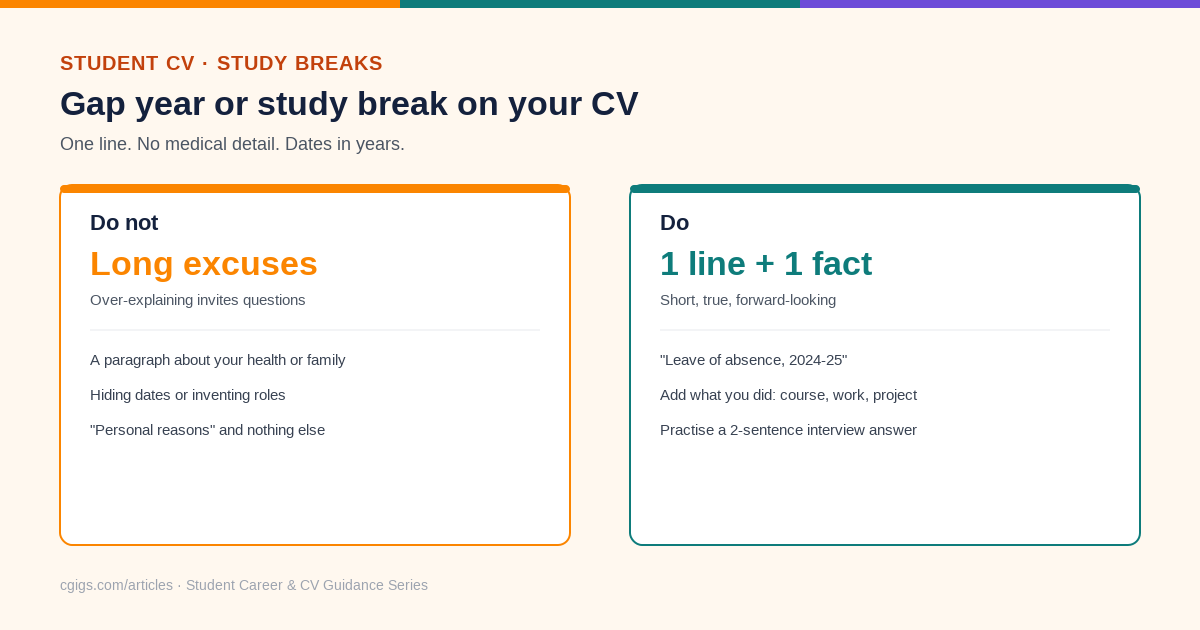
Rule: say what happened in the fewest words, then say what you did.
- Use a neutral label: "Leave of absence", "Study break", "Career break"
- Add a doing phrase if you have one: "Full-time role", "Online course", "Caring for a family member", "Travel"
- Stop. No diagnosis, no story, no apology.
You choose what to share. You don't owe an employer your medical history.
The legal side: what employers can and can't ask
United States
Under the Americans with Disabilities Act, employers generally can't ask disability-related questions before a job offer. The EEOC's enforcement guidance (10 October 1995) says an employer may not ask how many days an applicant was sick, and may not ask broad questions like "What impairments do you have?" Employers can still ask whether you can do the job's tasks, with or without accommodation.
That guidance doesn't cover gaps. So "What did you do in 2024?" is a normal question. A question about your health or diagnosis before an offer is not.
United Kingdom
Section 60 of the Equality Act 2010 makes it generally unlawful for an employer to ask about your health or disability before offering you a job, with limited exceptions. The Equality and Human Rights Commission publishes guidance for applicants and for employers. Health questions can come up after an offer.
This is general information, not legal advice. Rules differ by country and state. Check the pages in the Sources paragraph if it matters for you.
Where the gap shows: years or months?
Use years for school entries. Use months for jobs. Years make a short break less obvious and are still honest.
Is that hiding it? No. You state the break openly. You just don't draw a circle round five months. If an application form asks for exact dates, give exact dates.
Before and after: three CV lines
These are made-up examples to show the shape.
"Health reasons" is plenty. You can drop even that and write "Leave of absence, 2024-25".
In each one: a short label, true, and one fact that shows you were active. If you did nothing special, that's fine. Just write the label.
What to say in a cover letter
Most cover letters don't need to mention it. If the dates raise a question, one sentence is enough.
Pattern: what it was, when it ended, what has happened since. Past tense, forward-looking, no drama.
What to say in an interview
They may ask: "I see a break in 2024. Tell me about that." Practise a short answer out loud:
- You can say "I'd rather keep that private, but I'm happy to talk about what I did since"
- Don't lie or invent a job. References and background checks can catch it
- Don't blame a professor, your family or a past employer
- Don't over-apologise. A calm, short answer sounds confident
- Ask a friend to play the interviewer once. Saying it out loud twice is usually enough to steady your voice
- If they press for medical detail before an offer, steer back politely: "I'd prefer to keep that private. What I can tell you is what I have done since." A repeated push is worth noting as a signal about the employer
Do you need to explain it at all?
Think about who will see the dates. A recruiter sees your CV. A transcript, if requested, shows your real term dates. Your story should match both.
- Break under one term: often needs no extra line. Years-only dates cover it
- One term or more: one neutral line, as above
- A full year or more: one line plus what you did in it
- You did something big in it (job, volunteering, course, project): give it its own entry. Then it isn't a gap any more, it's experience
- You are unsure: ask your careers office. They see these cases every term
One more tip: say the same thing everywhere. If your CV says "leave of absence", your LinkedIn says "gap year" and your cover letter says "personal reasons", a reader will start to wonder. Pick one phrase and reuse it.
Quick checklist
Whether you're searching for a gap year graduate CV, a career break resume student layout or help with explaining a gap semester in an interview, the steps are the same:
- Reverse-chronological layout
- Years for school, months for jobs
- One neutral line, no medical detail
- One fact about what you did
- A short interview answer, practised out loud
- Nothing made up
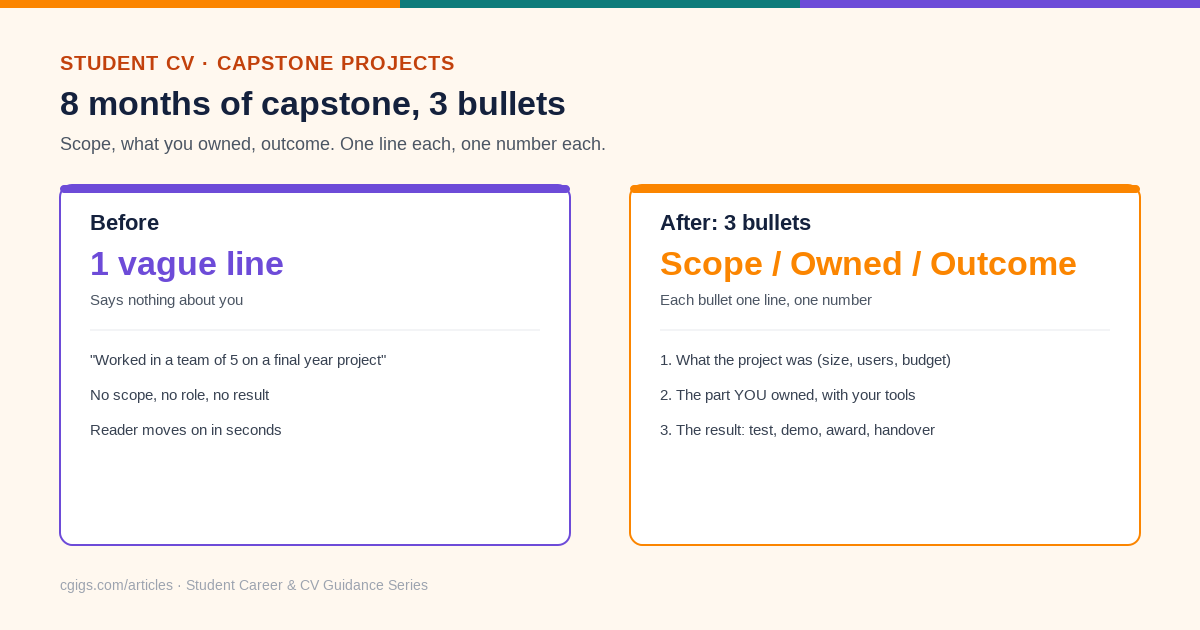
A strong project entry also helps the break fade into the background. See how to structure a capstone project in 3 bullets and one-page CV scan-time rules.
Sources (all checked 2026-11-26): Resume Genius hiring trends survey, 625 US hiring managers, started 29 Jan 2024 (page updated 5 Feb 2026): https://resumegenius.com/blog/job-hunting/hiring-trends-survey . US EEOC, Enforcement Guidance: Preemployment Disability-Related Questions and Medical Examinations, 10 Oct 1995: https://www.eeoc.gov/policy/docs/preemp.html . UK Equality Act 2010, section 60: https://www.legislation.gov.uk/ukpga/2010/15/section/60 . UK EHRC guidance for job applicants on pre-employment health questions (archive): https://archive.equalityhumanrights.com/sites/default/files/updated_pre-employment_health_questions_for_job_applicants.pdf . All CV wording, dates and numbers in the examples are made up for illustration.
Lay out your dates and study break cleanly in a one-page CV.
Build your CV free