Should your GPA go on your CV? Short answer: put it on if it helps you and the job asks for it. Leave it off if it does not. That is the whole rule. The rest of this guide shows you how to decide, with real numbers.
You will hear a "3.5 rule" from friends and forums. We explain where it comes from, what the official survey data says instead, and how to write results from the UK, Australia, Canada, India and Singapore.
What employers actually do with GPA
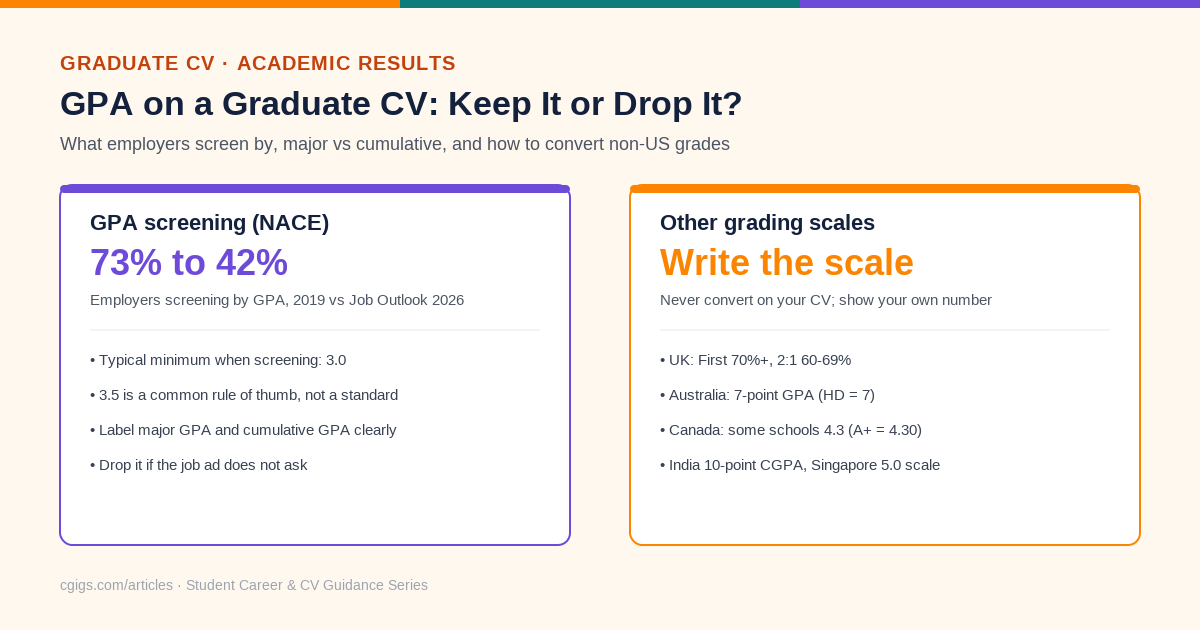
The best public source is NACE, the US National Association of Colleges and Employers. It surveys employers every year for its Job Outlook report. Here is what NACE has published:
What this tells you:
- GPA screening dropped a lot since 2019 (73% to 42%).
- It is still used by more than 4 in 10 employers in the NACE survey, so it has not gone away.
- NACE's 2026 release says that when employers screened in 2019, the minimum was typically 3.0, not 3.5.
- NACE links the fall to skills-based hiring. Employers also look at major, industry and internship experience.
Note: NACE's surveys cover employers who recruit US college graduates. They do not tell you the cutoff for one specific company. If a job ad states a minimum GPA, that number beats any survey.
Where the 3.5 rule comes from
There is no official 3.5 standard. We found no survey that sets 3.5 as a national cutoff, so treat it as a rule of thumb that students and career advisers pass around. It makes sense when you look at the maths on the usual US 4.0 scale:
So "3.5 or above" roughly means mostly A- and a few B+. Many students treat that as clearly strong. It is a good line for your own decision: above 3.5, the number helps you. Between 3.0 and 3.5, it is neutral. Below 3.0, it may block automatic screens that use a 3.0 cutoff.
Grade-point values differ a little by school. Check your own transcript key.
Cumulative GPA vs major GPA
- Cumulative GPA counts every graded course you took.
- Major GPA counts only courses in your major (some schools also count related courses).
They can be far apart. Early general courses can pull the cumulative number down while your major courses are strong. Worked example (made-up numbers, 4.0 scale):
Rule: GPA = total (credits x grade points) / total credits.
In this example the major GPA (3.89) is clearly stronger than the cumulative (3.52). Both are real. If you show only one, label it, so nobody thinks it is the other.
How to write it on your CV
Put it inside your Education entry, on the same line as your degree or on the line under it. Do not give it its own section.
Rules to follow:
- Always write the scale (/4.0, /4.3, /10, /5.0). A bare number is unreadable to a recruiter from another country.
- Use two decimals if your school does. Do not round up. 3.47 is not 3.5.
- Label the type: cumulative, major, or last two years.
- Report what your transcript says. Employers can ask for transcripts, and a mismatch can lose you an offer.
- If a job ad says "include your GPA", include it, even if it is not your best number.
Academic honors that can stand in for GPA. If your GPA is not your best feature, show the honor instead. Dean's List, University Honors, Latin honors (cum laude, magna cum laude, summa cum laude), Honours class, scholarships and prizes. The cutoffs for these are set by each school, so write the exact name your school uses, with the year. One short line, for example: Dean's List: Fall 2024, Spring 2025.
When to drop GPA entirely
Drop it when:
- It is below 3.0 and the job ad does not ask for it.
- You have 2+ years of strong work or internship experience. That will outweigh a number.
- You are applying to roles that care about skills, such as most software and design roles. NACE data above shows GPA screening is now a minority practice.
- Your scale is hard to read abroad and you cannot explain it in one line.
- You are changing field and your best proof is a project or portfolio.
Keep it when:
- The job ad asks for it, or an application form has a GPA field.
- It is 3.5 or above (a strong signal) or clearly higher than your peers.
- You have little work experience and need proof of effort.
- You apply for graduate school, scholarships or fellowships, which almost always ask.
About sectors: career offices often say that finance and consulting application forms tend to ask for GPA, while many tech employers care more about projects and experience. This is a common practitioner view, not a figure from a survey we can cite here, and we have not published any company cutoff. Look at each job ad.
Dropping GPA can raise questions in an interview, so have an honest sentence ready: "My strongest work is in my major courses and my projects. I would be happy to share my transcript."
Non-US grades: how to convert (and why not to put it on your CV)
Official conversion is done by the university or a credential evaluator such as WES, not by you. WES says its conversions use the most common grading scales for your country of education, and evaluators use course-by-course tables. Simple maths gives only an approximation, but it helps you understand where you stand. Here is each scale and the arithmetic.
Worked example, same student in five systems. The numbers are made up and the "x 4.0" conversions are rough only:
The Australian scale does map to percentages: Queensland government's graduate programme lists 7 = 85-100%, 6 = 75-84%, 5 = 65-74%, 4 = 50-64%. The UK class bands above (70/60/50/40) are the common ones, but each university sets its own regulations, so check yours. NUS lists honours at GPA 4.50 and above (Highest Distinction), 4.00 to 4.49 (Distinction) and 3.50 to 3.99 (Merit).
Why you should not publish the converted number: evaluators often use tables, not straight scaling, so their result can differ from the formula above. An 8.4 on a 10-point scale does not have to become a 3.36. If you print your own conversion and the employer's checker gets a different one, it looks like you inflated the number.
What to do instead:
- Write your native result with its scale: CGPA 8.4/10, [your university], using the exact class wording on your transcript if it has one.
- Add a short note about the scale only if your school publishes one, such as a rank or a class.
- If an application needs a US-style GPA, use the official evaluation the employer or school accepts (WES or the institution's own letter).
UK students: you do not use GPA at all. Write your class or predicted class, plus relevant module marks. Our one-page graduate CV guide shows where to place Education so recruiters see it in the first seconds.
Short decision list
1. Does the ad ask for GPA? Include it.
2. Is it 3.5 or above? Include it, labelled with the scale.
3. Between 3.0 and 3.49? Include it if you have little experience, otherwise your call.
4. Below 3.0? Drop it unless required. Lead with projects, internships and skills.
5. Strong major GPA, weaker cumulative? Show the major GPA, labelled.
6. Non-US scale? Write it natively, with the scale.
For more on how employers hire entry-level staff, see our internship and job offer numbers article.
Sources (all checked 2026-11-26):
- NACE, Skills-Based Hiring Grows, but College Students Don't Fully Understand It (23 Jan 2026): https://www.naceweb.org/about-us/press/2026/skills-based-hiring-grows-but-college-students-dont-fully-understand-it
- NACE, Nearly Two-Thirds of Employers Use Skills-based Hiring Practices for New Entry-level Hires (7 Nov 2024): https://naceweb.org/talent-acquisition/trends-and-predictions/nearly-two-thirds-of-employers-use-skills-based-hiring-practices-for-new-entry-level-hires
- WES tools (iGPA): https://www.wes.org/wes-tools
- University of Queensland, final grades and GPAs: https://my.uq.edu.au/information-and-services/manage-my-program/exams-and-assessment/final-grades-and-gpas
- Queensland Government Smart Jobs, GPA conversion table: https://smartjobs.qld.gov.au/grads/tipsapplicationsgpa.html
- Dalhousie University, grade scale and definitions: https://www.dal.ca/campus_life/academic-support/grades-and-student-records/grade-scale-and-definitions.html
- Imperial College London, Understanding grades: https://imperial.ac.uk/students/success-guide/ug/assessments-and-feedback/improving-through-feedback/understanding-grades
- National University of Singapore, transcript information grade legend: https://www.nus.edu.sg/registrar/docs/default-source/administrative-policies-procedures/transcript-information-grade-legend.pdf
The 3.5 rule of thumb, the sector comments and all "x 4.0" conversions are practitioner conventions or our own arithmetic, not published standards. Every worked example is made up.
Get your Education section, GPA line and honors laid out cleanly.
Build your CV free