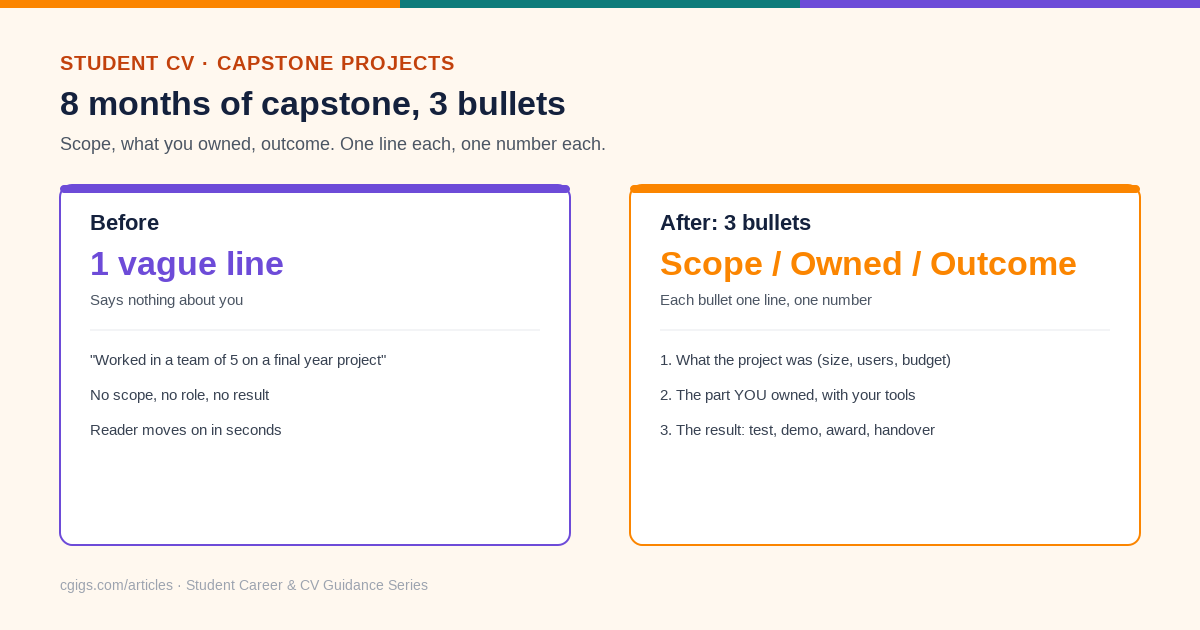
Your capstone took 8 months. Late nights, three rewrites, one good demo. On your CV it gets one line: "Worked in a team on a final year project."
That line wastes the best thing you have. For most graduates, the capstone is the biggest piece of real work so far. This guide shows how to fit it into 3 bullets that a reader gets in seconds.
Why 3 bullets and not 10
Recruiters don't read your CV slowly. A widely quoted eye-tracking study from TheLadders (2018) put the first look at about 7.4 seconds per CV. It is one study and most coverage of it is second-hand, but the lesson holds: you get a glance, not a read. (More on this in the one-page graduate CV guide.)
So a capstone entry must be short and easy to scan. Three bullets do three jobs:
Bullet 1: scope
Say what the project was in one line. Give it size.
- Who it was for: a client, a sponsor, a lab, a competition, or the course itself
- How big: users, data rows, budget, devices, number of subsystems
- How long: 8 months, 2 semesters
- Team size: write it honestly, e.g. "team of 5"
Skip the course code. Nobody outside your department knows what ENG-4902 means.
Bullet 2: what you owned
This is the bullet that matters most. A reader is checking whether you did something, not your team.
- Start with a verb that fits your part: designed, built, tested, modelled, wrote, led
- Name the piece: the database, the gearbox, the PCB, the cleaning pipeline
- Add the tools in plain words. They also work as keywords for CV scanners
- Write "I" things, not "we" things. "We built an app" hides you.
Bullet 3: the outcome
End with something a stranger could check. From strongest to weakest:
- A number from a test (latency, accuracy, tolerance, efficiency, uptime)
- A real handover: the client used it, the lab kept it, the sponsor asked for a second phase
- A grade, award or showcase place (say what it was out of)
- A demo date and what the demo showed
No number? Say what was delivered. Never make a number up. If a mark is the only result you have, a mark is fine.
The Google XYZ link
This 3-bullet pattern is the Google XYZ idea spread over three lines. Laszlo Bock, who ran people operations at Google, described the formula as: "Accomplished [X] as measured by [Y] by doing [Z]." Retellings of it differ a little in word order, so treat it as a checklist, not a script.
In a capstone: X is the result, Y is the number, Z is your piece. Bullet 3 holds X and Y. Bullet 2 holds Z. Bullet 1 sets the stage. For 15 more examples of the formula, see our XYZ examples.
Before and after: 3 majors
Every example below is made up to show the shape. Swap in your own facts and numbers.
Look at what changed. Each AFTER entry has a header line (project, team size, length, who it was for) plus three bullets. Each bullet is one line and carries one fact a reader can check.
State your team size and role honestly
Interviewers will ask. Your answer has to match the page.
- Put the team size in the header. "Team of 5" is honest and normal.
- Don't claim the whole thing. "Built a platform" is false if you built the login page. Say "Built the booking API for a clinic platform".
- Say "led" only if you were the lead. If you ran meetings and set tasks, say so. If everyone shared it, say "co-led" or leave it out.
- Show teamwork without taking credit. "Agreed a shared CAN interface with the electronics sub-team" shows cross-team work and keeps credit clean.
Sponsors, clients and NDAs
Naming the company
- If the company is happy to be named, name it. A real client or sponsor is worth more than a course label
- Ask first. A short email works: "We'd like to list the project on our CVs. Is that okay?"
- If they say no, write "for an industrial sponsor in the energy sector"
If there is an NDA
An NDA binds you. Read it, or ask your supervisor what it covers. This isn't legal advice, just a safe way to work:
- Describe the problem in general terms, not the product, design, data or code
- Use ranges or relative numbers ("cut test time by about a third") only if the NDA lets you
- Don't link to code or put screenshots on your CV
- Ask your supervisor or sponsor to approve the exact wording, and keep their reply
- In interviews say: "I can't go into detail, but I can explain the method I used"
Where it goes on the page, and how many lines
Projects or Experience? Pick by what else you have.
Line budget on a one-page graduate CV (a rule of thumb, not a law):
The capstone gets the most room because it is your biggest work. Don't give it 10 lines. A short entry reads faster, and you can tell the rest in the interview.
How to get from 8 months to 3 bullets
Don't start by writing bullets. Start with a dump, then cut.
Common mistakes:
- Listing every tool you touched. Pick the 3-4 you really used
- Describing meetings, reports and presentations. Every student did those
- Writing the project title as if it were a result
- Passing off the team's number as yours. Say "our system" when it is true, and point to your piece inside it
- Telling the capstone differently on the CV, LinkedIn and cover letter. Keep the facts identical and change only the length
Quick checklist
- Header has project name, team size, length and who it was for
- Bullet 1 gives scope with one number
- Bullet 2 starts with a verb and names YOUR part and your tools
- Bullet 3 ends in something checkable
- No made-up numbers, no "we" hiding your part
- NDA and sponsor wording cleared
- Fits in 4 lines
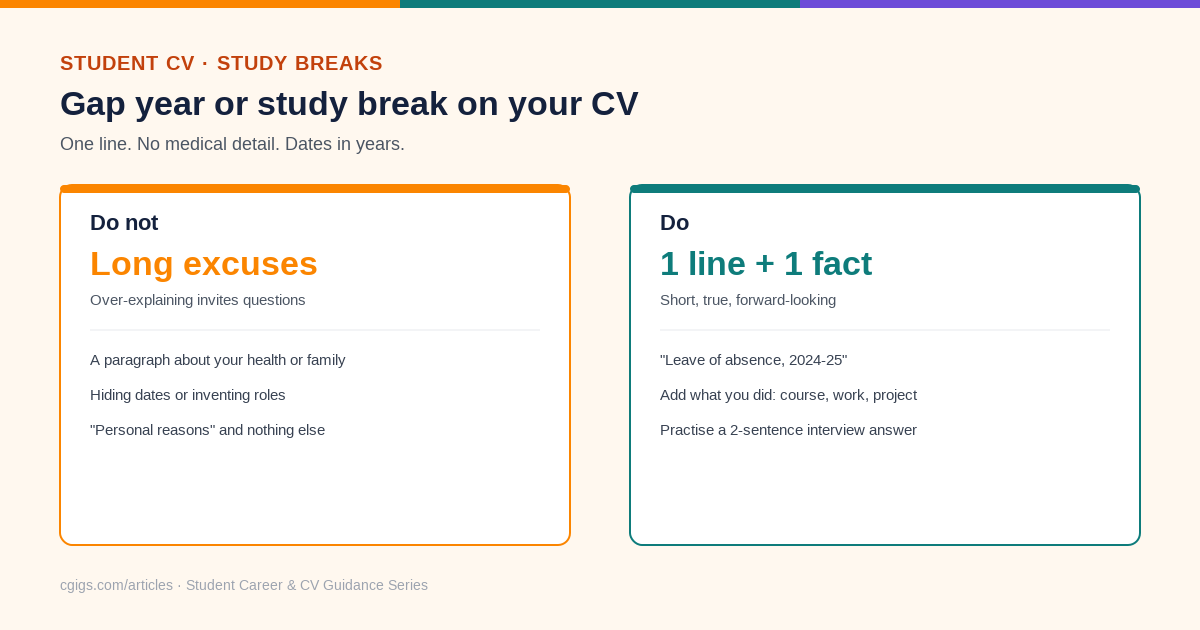
Did your capstone run across a leave of absence? Read how to explain a study break on a graduate CV.
Sources (all checked 2026-11-26): TheLadders eye-tracking study, 2018, as reported by HR Dive: https://www.hrdive.com/news/eye-tracking-study-shows-recruiters-look-at-resumes-for-7-seconds/ . Laszlo Bock's XYZ formula, as reported by Inc.: https://www.inc.com/melanie-curtin/job-hunting-a-google-executive-says-to-use-this-3-part-resume-formula-to-stand-out.html . All project examples, team sizes and numbers in this article are made up for illustration.
Turn your capstone into 3 clean bullets and a one-page layout in minutes.
Build your CV free