You have little experience, so you list your coursework. Then you list all of it. Fifteen courses, four lines, and the recruiter's eye slides over every one. A short list of four courses that match the job reads better and leaves room for a project. Below is the arithmetic, a bad and a good example, and rules for CS, mechanical engineering and business students. The student in the examples is made up.
When coursework helps, and when it hurts
It helps when:
• You have no internship yet. Coursework is your proof you know the subject.
• You changed majors or fields, and need to show the new subject.
• The job posting names a subject (for example "distributed systems") and you took it.
• Your resume is short on content and has spare lines.
It hurts when:
• You already have an internship or two projects that show the skill. Use the space for those.
• The list pushes a project bullet off page one.
• The list is every course you took. Readers cannot find the 4 that matter.
Career centers agree on the basics. The University of Vermont career center says relevant classes can show knowledge and technical skills and can fill out a resume that is short on content, and suggests about four to eight classes. Treat it as a space-filler for the early stage, not a must-have.
The line budget, worked out
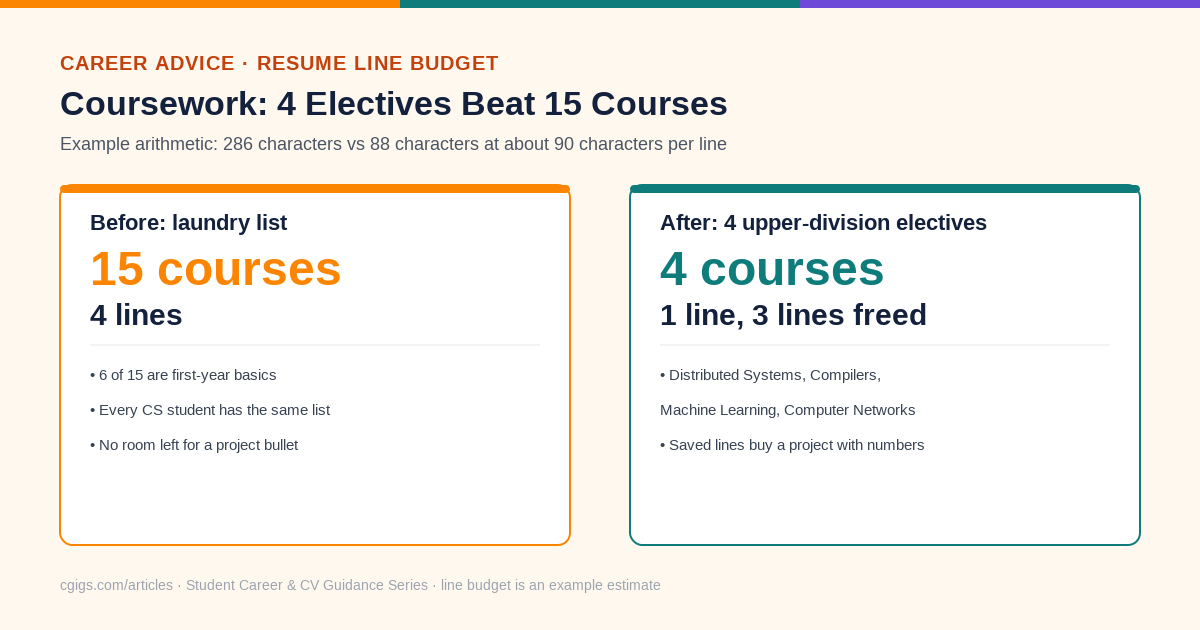
A one-page resume has a fixed number of lines. Every line you spend on one thing is a line you cannot spend on another. Here is the maths with our assumptions (10.5 pt font, 0.6 in top and bottom margins, 1.15 line spacing, about 90 characters per line). These are estimates for a typical layout. Your template will differ, so measure your own page.
3 lines out of 46 is not much, but it is a full project bullet and a half. Put another way: the laundry list spends 4 lines on text a recruiter has seen on every other student's resume. A project bullet with a number in it is something nobody else has.
Bad: the laundry list
Made-up student: CS senior, GPA 3.4, applying for backend internships.
What is wrong:
• 15 courses, 286 characters, 4 lines.
• 6 of the 15 are first-year basics (calculus, physics, English, intro courses). Every CS student has them.
• The 2 or 3 courses that matter (Operating Systems, Databases) are buried in the middle.
• "Technical Writing" and "English Composition" do not match anything in a backend posting.
• No room is left for a project. This page has no proof of any work.
Good: four electives that match the job
What changed:
• The coursework line shrank from 4 lines to 1.
• Every course on it is upper-division and could appear in a backend posting.
• The 3 saved lines buy a project. The project bullet uses a course as context ("Distributed Systems project") and shows a result (3 nodes, 1 node killed, 20 of 20 runs). The numbers here are invented for the example.
• The recruiter can now see you took the course and built something with it.
How to pick the 4
Rules we use:
• Open the job posting. Underline the subjects it names. Match courses to those first.
• Prefer upper-division courses (usually 300 and 400 level in the US, years 2 and 3 in UK-style degrees). They are the ones that separate you from the next student.
• Drop anything every student in your major must take, unless the posting names it.
• Never list a course you are taking only in the future unless you mark it: "Compilers (in progress, Spring 2027)".
• Change the 4 per application. It takes 30 seconds.
Examples for three majors
The same logic works in any field. A mechanical engineering posting for a design role names finite element analysis and machine design, so those go in. A finance posting names modeling and corporate finance, so "Principles of Management" stays off the page. If you cannot tell which courses matter, the job posting is the answer key.
Formatting rules
• One line under the degree. Label it "Relevant coursework". Do not make a separate section for 4 courses.
• Course titles, not numbers. The UVM career center says numbers mean nothing outside your university. Use the title. Add a code only if the posting or your school's own career office asks for it (our practitioner rule, not a standard).
• Grades only if strong. "Machine Learning (A)" is fine. A B-minus is not worth the characters. If your overall GPA is weak, leave the grades out and let projects speak.
• No descriptions. If a course needs a sentence, it belongs in a project bullet, as in the good example.
• Commas on one line. Two columns of bullets use more space than they earn when you only list four.
What an ATS does with course names
There is no public rule that applicant tracking systems score course names differently from other text. What we do know comes from a vendor. Jobscan, a resume-checking company, says it puts hard skills first when it compares a resume with a posting, and advises that each required skill appears in the same form the posting uses. That is a marketing source for its own tool, not an independent test of any employer's system. What follows is practitioner advice, not measured fact: if the posting says "machine learning", write "Machine Learning" in full, not "ML Methods II". Use the plain title your school uses, and put the same skill in a project bullet too, so the word appears in more than one place. Note also that NACE's Job Outlook 2022 survey found employers rated a candidate's major higher than a GPA of 3.0 or above in influence (average 3.8 against 3.1 on a 5-point scale), so showing depth in your major through a few strong courses is a sound use of the line.
Next: put your projects on one clean page and pick the right technical skills section. If you code, read the student portfolio README guide too, so the project you use the saved lines for has a README that backs it up.
Sources (all checked 2026-11-26): University of Vermont Career Center, Including Relevant Coursework on Your Resume, https://blog.uvm.edu/career-center/including-relevant-coursework-on-your-resume/ (checked 2026-11-26). NACE Job Outlook 2022 candidate selection spotlight, https://www.naceweb.org/talent-acquisition/candidate-selection/employers-prefer-candidates-with-work-experience/ (checked 2026-11-26): average influence of a 3.0+ GPA 3.1 and of the major 3.8 in the 2022 survey, scale of 5. Jobscan, ATS resume advice, https://www.jobscan.co/blog/ats-resume/ (checked 2026-11-26), vendor source. The student, courses, project numbers and the line budget (a layout estimate) are made-up examples.
Give your four best courses one clean line on a one-page CV.
Build your CV free