You got an offer. You are on a student or graduate visa. Can you ask for more money?
Yes, usually. But a visa can set a floor under your salary, and it can decide which parts of the pay even count. If you ask for the wrong thing, you can make the offer harder for the employer to sponsor.
This guide shows what the official sources say, with dates. It has one worked comparison of two offers. The offers are made up; the thresholds and tax bands are real.
This is not legal advice. Rules change, and your case is yours. Before you reply to an offer, talk to your school's international office.
Step 1: know the market number (base pay only)
Two public sources give you a starting range.
How to read it:
• NACE counts base salary only. No bonus, no commissions, no benefits. It was 150 employers, a 20.3% response rate, surveyed 8 Oct to 30 Nov 2025.
• BLS covers all software developers, so the median is pulled up by experience. The 10th percentile ($82,460) is a better hint for an entry-level floor than the median.
• Sites like Levels.fyi are self-reported by users. Use them as a range, not a promise.
• Pick a target range, not one number. Example: ask at the middle of your range, accept above the bottom.
Step 2: know your visa floor
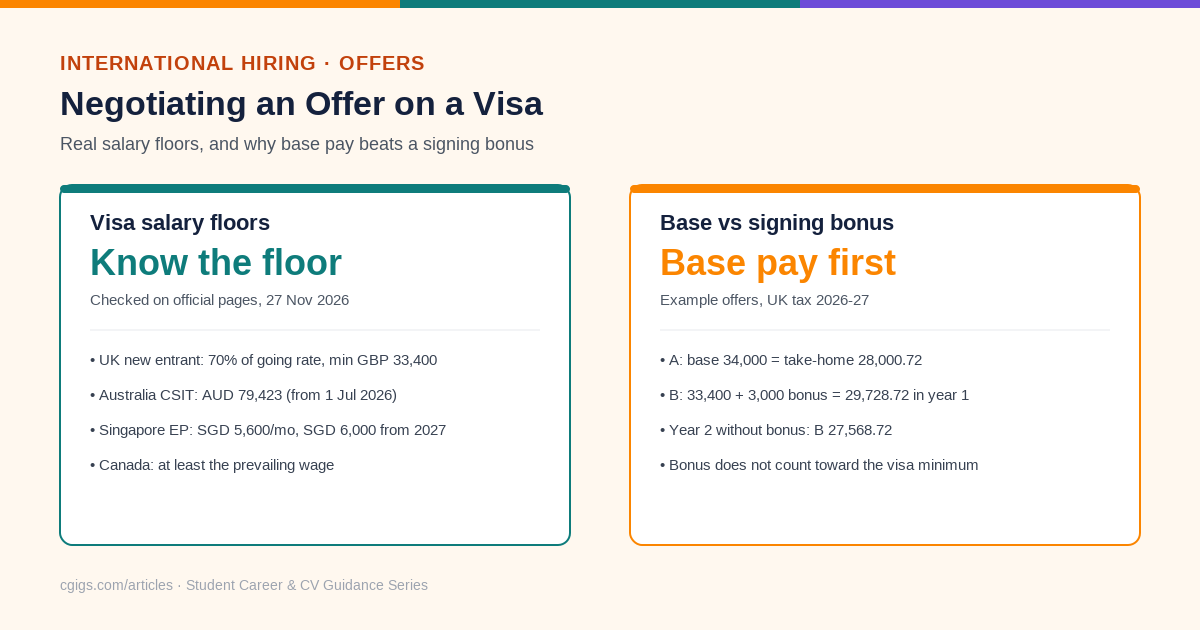
Some visas set a minimum salary for the employer. Below it, they cannot sponsor you. Here are the official figures we could check on 2026-11-27:
What this means for you:
• UK. The new-entrant route lets an employer pay less, but the total time on this route plus the Graduate visa is capped at 4 years. Read our UK Graduate visa guide for the 2-year window.
• Singapore. The EP minimum rises with age and goes up from 1 Jan 2027. A job at the old number may not work for a new application next year. Our COMPASS guide explains the points side.
• Australia. The threshold is a nomination rule for the employer. It is indexed every year, so check the date your employer will lodge.
• Canada. The employer has to pay at least the greatest of the Job Bank regional median and what they pay current staff in the same job. That floor is the employer's problem, but it tells you the offer cannot be low.
• US. There is no single salary floor like these for F-1 work (OPT). The salary matters at the H-1B lottery. See the next section. Our STEM OPT guide covers the timeline.
Step 3: in the US, base pay changes your lottery odds
Since the FY2027 H-1B registration, selection is weighted by wage level. The rule was published 29 Dec 2025 and took effect 27 Feb 2026. Higher wage level means more entries in the pool.
These are DHS's own estimates in the rule, not a promise for any one person. The point: a few thousand dollars of base pay can move you up a level. Ask the employer which wage level and occupation code they will use. Also ask whether the wage will match the final petition.
Visa fees and rules for H-1B have been changing, so confirm the current state with your school's international office.
Step 4: base vs signing bonus vs relocation
For you, the three parts behave differently:
• Base salary. Counts toward visa thresholds. Future raises and bonuses are often a percentage of it. Push here first.
• Signing bonus. A one-off. UK sponsor guidance (version 04/26) says one-off payments such as signing bonuses do not count toward the salary requirement. Often has a repay clause if you leave in the first year. Ask for the clause in writing.
• Relocation. Also not base pay. Useful if you are moving countries, but it does not help the threshold.
Cost-of-living adjustments work the same way. If a company has pay bands by city, ask which band applies to your office. If an allowance is paid on top, assume it does not count toward a visa minimum unless the employer's immigration adviser says it does.
Worked example: two offers (made-up), UK, tax year 2026-27
Both offers are for the same job. Say the job's going rate is GBP 44,000 (example). 70% of that is GBP 30,800, which is below the GBP 33,400 minimum, so the floor of GBP 33,400 decides. You are on the Graduate visa and moving to the new-entrant route.
Read it like this:
• B pays more in the first year because of the bonus. A pays more in year 2 by GBP 432 a year.
• This ignores pension, student loan, any repay clause, and raises. If B's raises are a percentage of a lower base, the gap closes fast.
• Add rent. Example only: GBP 1,000 a month in rent leaves A with about GBP 16,001 in year 1 and B with about GBP 17,729.
• Both are legal for the visa in this example because both base salaries are at or above the floor. If B's base were GBP 33,000 plus a GBP 4,000 bonus, it would fall below the floor, because the bonus does not count.
So a good ask is: "Could the base be GBP 35,000?" not "Could you cut the base and add a bonus?"
How to avoid a rescinded offer
Offers get withdrawn when the paperwork does not fit. Reduce the risk:
• Say your status early. Tell the recruiter what you need (sponsorship, work-permit type, start date). Do it before the final round.
• Never lower your ask below the visa floor. Do not offer "I'll take less" below the legal minimum.
• Get the offer in writing with title, base pay, start date and any bonus or repay terms.
• Ask who is handling the visa and what the timeline is. Do not resign from another job, sign a lease or book flights until the employer confirms the visa step.
• Ask if the employer is cap-exempt. Some universities and research bodies are, and that can change the US timeline.
• Keep your tone calm. Ask, thank, ask again. One counter is normal.
A short script you can copy
Sources (all checked 2026-11-27):
• GOV.UK, Skilled Worker visa: your job (salary): https://www.gov.uk/skilled-worker-visa/your-job
• GOV.UK, Skilled Worker visa: when you can be paid less: https://www.gov.uk/skilled-worker-visa/when-you-can-be-paid-less
• GOV.UK, Sponsor a Skilled Worker guidance 04/26: https://www.gov.uk/government/publications/sponsor-a-skilled-worker
• GOV.UK, Income Tax rates and Personal Allowances: https://www.gov.uk/income-tax-rates
• GOV.UK, National Insurance rates and categories: https://www.gov.uk/national-insurance-rates-letters
• Australian Department of Home Affairs, salary requirements to nominate a worker: https://immi.homeaffairs.gov.au/visas/employing-and-sponsoring-someone/sponsoring-workers/nominating-a-position/salary-requirements
• Singapore MOM, Employment Pass eligibility: https://www.mom.gov.sg/passes-and-permits/employment-pass/eligibility
• Canada ESDC, Global Talent Stream requirements: https://www.canada.ca/en/employment-social-development/services/foreign-workers/global-talent/requirements.html
• Federal Register, weighted selection final rule (29 Dec 2025): https://www.govinfo.gov/content/pkg/FR-2025-12-29/html/2025-23853.htm
• NACE, Salaries expected to climb for class of 2026 grads: https://naceweb.org/about-us/press/2026/salaries-expected-to-climb-for-class-of-2026-grads-despite-flat-hiring
• BLS, Software developers (OOH): https://www.bls.gov/ooh/computer-and-information-technology/software-developers.htm
The job going rate, both offers, the rent and the script are examples we made up. The tax lines use the 2026-27 England bands; Scotland differs. The two-year total uses a flat weekly-to-annual NI approximation.
Get a CV that backs up the number you are asking for.
Build your CV free