You have 140 competitors for one graduate job. Someone has to read 140 cover letters. Do you think they read a wall of text?
This guide gives you a short letter that gets finished. It has 3 paragraphs and about 250 words. You get the blueprint, a full worked example with a word count per paragraph, and a before and after of a weak opening. The candidate, company and numbers in the example are made up.
Why short wins: the numbers
Here is what we could source. Two different countries, so do not mix them.
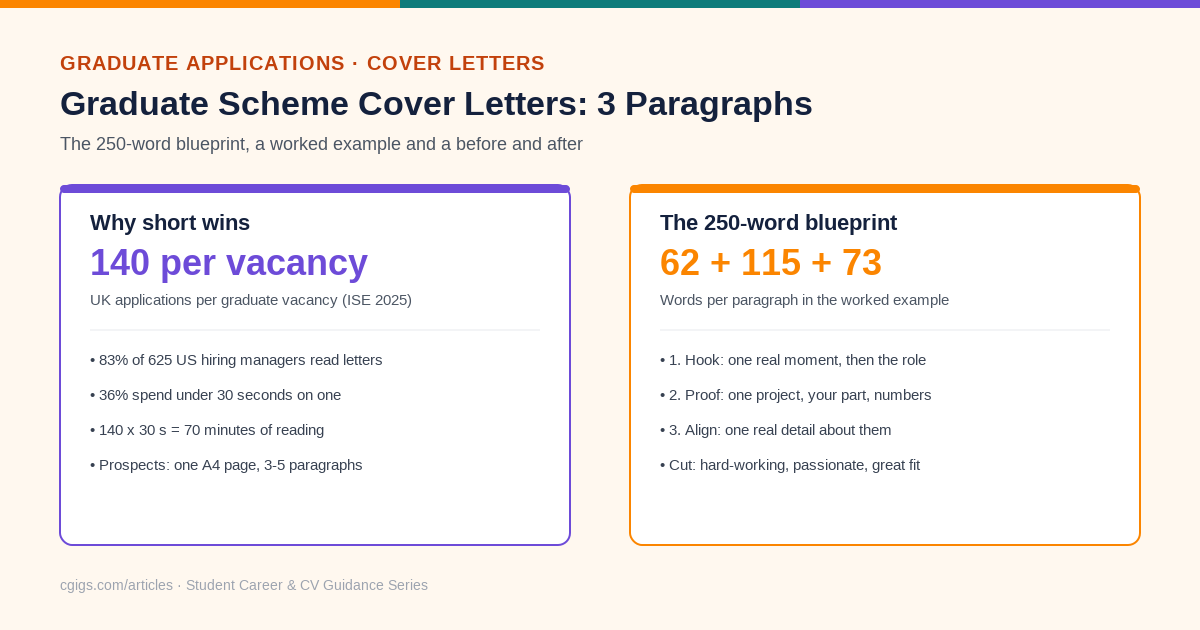
• UK: employers in the ISE Student Recruitment Survey 2025 got an average of 140 applications per graduate vacancy. It was 86 in 2022/23 and 38 in 2002/03. Internships got 101 per vacancy.
• US: Resume Genius asked 625 US hiring managers. 83% said they always or frequently read cover letters. 45% read the letter before the resume.
• Time spent (same survey): 36% spend under 30 seconds, 48% spend 30 seconds to 2 minutes, 15% spend more than 2 minutes.
Resume Genius sells CV tools, so treat its survey as a signal, not a law. Its page also gives two different years (2022 and 2023) for the data.
The same survey says hiring managers prefer letters of about 400 words on average. That is a ceiling, not a target. Prospects, the UK graduate careers site, says to keep it to one A4 page and three to five concise paragraphs, and that recruiters generally prefer shorter letters. Our blueprint sits at the short end of both: 3 paragraphs, 250 words.
The 3-paragraph blueprint
Why one project and not five?
• Your CV already lists the rest. Prospects says the same: complement your CV, do not duplicate it.
• One story with numbers is easier to remember than a list of skills.
• It gives the interviewer a first question to ask.
Pick the project that best matches the advert. If you are a junior engineer, a capstone, a hackathon build or a repo with a good README all work. See how to write the README they click on.
Before and after: the opening
What changed:
• The before could be sent to any company. The after could only come from one person.
• "Hard-working" and "passionate" are claims. The lab story is evidence.
• The role name and where you found it still appear, as Prospects advises. They just come second.
A full 250-word example
Everything here is an example: Priya, Northfield Software, the booking app and every number. Copy the shape, not the words. Word counts per paragraph: 62 + 115 + 73 = 250 (greeting and sign-off not counted).
How to cut the boilerplate
Go through your draft line by line. Delete or replace these:
• "I am writing to apply for..." with the role, the story first.
• "I am a hard-working team player" with one fact that shows it.
• "I have always been passionate about technology" with what you built last term.
• A sentence that repeats a CV bullet. Prospects says to avoid repeating the CV.
• "I believe I would be a great fit" with the match between their advert and your project.
• "Thank you for your time and consideration" with one clear ask: a conversation.
Match the advert. Prospects says to use keywords from the job advert and to back up claims with concrete examples. If the advert says "tested code", say you wrote tests. If it says "teamwork", name your part in a team project.
Quick checks before you send
• Count the words. 250 is the aim, 300 is the limit.
• Fits on one page with the same font as your CV.
• Named contact if you can find one. Prospects says to use "Yours sincerely" with a name and "Yours faithfully" without.
• One project, with your part and two numbers you can defend in an interview.
• Every number is real. If you cannot back it up, cut it.
• Company detail checked: you read their post, their scheme page or their graduate FAQ.
• Salary, only if they ask for it.
• The CV link and project link work from a clean browser.
Then make the CV and letter agree. Write the project bullet with the Google XYZ formula, and if the project was your final-year work, shape it with the 3-bullet capstone entry.
Sources (all checked 2026-11-27): Prospects, Cover letters, https://www.prospects.ac.uk/careers-advice/cvs-and-cover-letters/cover-letters (length, paragraph count, structure, tailoring advice). ISE, ISE top 10 stats of 2025 you need to know, https://ise.org.uk/knowledge/insights/513/ise_top_10_stats_of_2025_you_need_to_know/ (140 applications per graduate vacancy, 86 in 2022/23, 38 in 2002/03, 101 per internship) and ISE Student Recruitment Survey 2025, https://ise.org.uk/_userfiles/pages/files/reports/student_recruitment_survey_2025.pdf. Resume Genius, Cover letter statistics (625 US hiring managers, Pollfish; page shows 2022 and 2023), https://resumegenius.com/blog/cover-letter-help/cover-letter-statistics. The reading-time sums are our arithmetic. Priya, Northfield Software and all letter numbers are made-up examples.
Letter drafted? Now build the one-page CV that goes with it.
Build your CV free