You apply for a graduate or intern role. A week later an email says "complete this assessment". What is it? A 70-minute timed quiz, a take-home project, a live coding call? Often it is all three, one after another.
This guide splits the early-career screening stages apart. For each one you get what it is, how long it runs, what is graded and how to prepare. At the end there is a 4-week plan with problem counts per topic. Where a number comes from a company or survey we say which. Where it is our own suggestion, we say that too.
The stages at a glance
Sources for the table: CodeSignal, Amazon Jobs, Salesforce Trailhead and candidate reports on Glassdoor. Links are at the bottom. Every employer sets its own test, so your invite email beats this table.
Stage 1: the timed quiz (70 minutes, 4 questions)
This is the one most students meet first. Facts we could check:
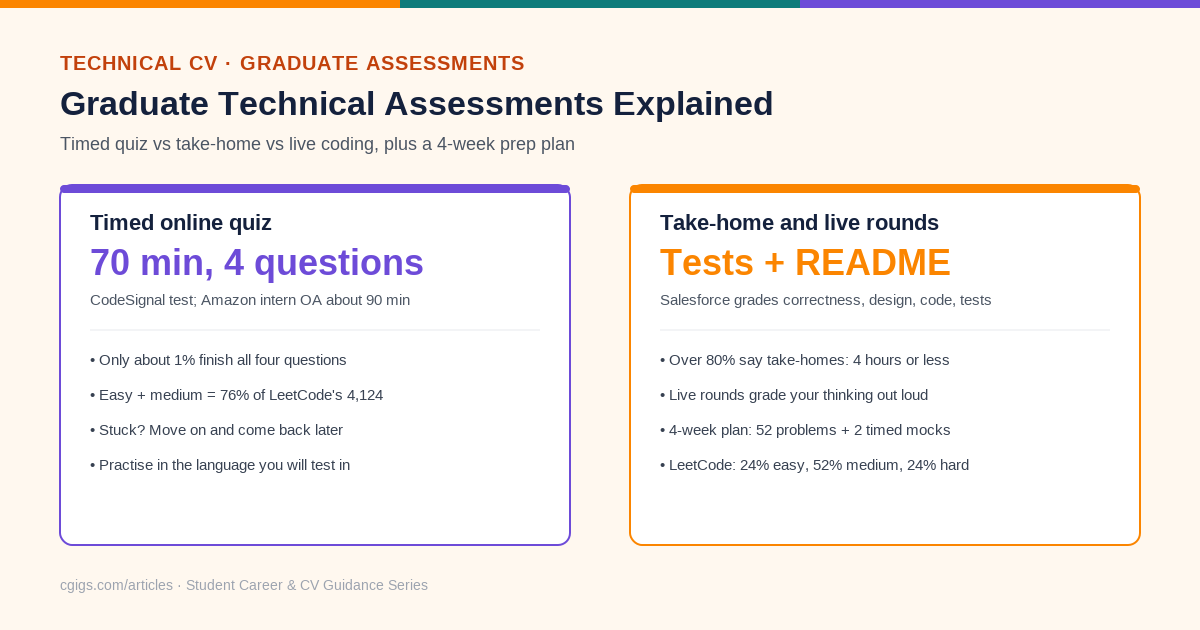
• CodeSignal's CEO says its General Coding Framework has four questions in about 70 minutes.
• He also says "almost no company expects you to finish all four", and that very few people, maybe 1 percent, finish all four.
• Amazon's page for SDE internships says the online assessment takes about 90 minutes: coding averages 70 minutes, a work-style survey 15 and a feedback survey 5. No Amazon-specific knowledge is needed.
• Amazon's tips: if you are stuck, move on and come back. Use a laptop or desktop, not a phone.
• HackerRank and Codility tests are set by each employer, so length varies. Read your invite.
Why not aim for a perfect score? Because the people who built the test say almost nobody gets it. Get Q1 and Q2 fully right, then take what you can on Q3. A tested, working simple answer beats an unfinished clever one.
What the practice bank looks like
LeetCode is the most common place to practise. We counted its public problem list on 2026-11-27. Treat it as a snapshot, because the bank grows.
What this means for you:
• Three quarters of the bank is easy or medium. For an intern or graduate quiz, that is where your time should go.
• Hard problems are about 1 in 4 of the bank. Do a few late in your plan, not early.
• LeetCode does not publish how often each difficulty appears in company tests. We have no sourced number for that, so we will not guess one.
• HackerRank's 2025 developer survey: 62% say they feel they must over-prepare for LeetCode-style tests, and 77% say most tests do not match the real job. So the quiz is a filter, not a picture of the work. Do not take it personally.
Stage 2: the take-home project
A take-home means a small build with a time limit, often an API or a small app. Facts we could check:
• Salesforce's candidate page for a HackerRank take-home says the email gives your time limit and a link that expires in seven days. The timer starts when you click it.
• They grade it "as if you are writing an actual application for deployment": correctness, scale awareness, design quality, code quality and a quality mindset, including automated tests.
• Their tips: read the whole problem first, write your assumptions in the notes, check edge cases, add tests, and submit before time runs out.
• In a survey of almost 700 interviewing.io users, over 80% said a take-home should take 4 hours or less, and a plurality said 2 hours is ideal. 66% complete take-homes all or most of the time. (The article gives no year; it is a self-selected user survey.)
We found no sourced figure for a typical "48-hour" window, so check your own deadline in the invite.
Small things that stand out:
• A README with a 3-command quickstart. See the 5-section README guide.
• A short list of what you left out and why. "No auth, to keep to the time limit" is a good line.
• Commits that tell a story, not one giant commit.
• Do not go far over the stated time. A cleaner, smaller answer scores better than a huge rushed one.
Stage 3: live coding, pairing and system design
Salesforce says its live coding is graded on your thinking process as well as your output. Their tips:
• Restate the problem to check you understood.
• Think out loud.
• Get a working answer first, then improve it.
• Mention time and space cost yourself.
• If you are stuck, say so and say how you would get unstuck.
For system design they say interviewers want your thinking, and not every role includes it. Clarify scope, scale and limits first, then talk through trade-offs. For interns it is often absent. Ask your recruiter which rounds you will get and how long each runs.
Reports from candidates on Glassdoor describe live rounds of about 45 minutes. These are individual accounts, so treat the number as a rough guide.
A 4-week prep plan with problem counts
This plan is our suggestion, not an official method. It assumes about 1 hour a day, 5 days a week. The total is 52 topic problems and 2 timed mock tests. Do the easy ones first within each topic. Solve in the language you will use in the test.
Rules that make it work:
• For each problem, give yourself 20 minutes. If you are stuck, read the answer, then solve it again tomorrow from scratch.
• Keep a short log: problem, topic, time, what tripped you. Review it on Fridays.
• In week 4, practise out loud with a friend. Pairing is a speaking skill too.
• Skip dynamic programming mastery if you are short of time. Basic DP is enough for most early-career tests.
• Put the project you build in week 4 on your CV. Use the 3-bullet capstone format to write it up.
Checklist for the day
• Test the laptop, internet and browser the night before.
• Close other tabs. Some platforms log browser activity, and Amazon says not to paste code.
• Take the practice test if one is offered. Amazon's practice test has 2 questions and is not scored.
• Read all questions first, then start with the easiest.
• Run your code on small and empty inputs before you submit.
• Write down assumptions in the notes box.
• Submit with time to spare.
Sources (all checked 2026-11-27): CodeSignal, advice from our CEO on prepping for tech interviews and assessments, https://codesignal.com/blog/advice-from-our-ceo-on-prepping-for-tech-interviews-and-assessments/ (4 questions, about 70 minutes, about 1 percent finish all four). Amazon Jobs, Online assessment for SDE, https://atoz.amazon/en-us/jobs/hiring-process/online-assessment/university/software-development-engineer (internship OA about 90 minutes, coding average 70). Salesforce Trailhead, Ace the technical assessments, https://trailhead.salesforce.com/content/learn/modules/strategies-for-successful-software-engineer-interviews-26/ace-the-technical-assessments (take-home grading, 7-day link, live coding and system design tips). interviewing.io, Why engineers don't like take-homes, https://interviewing.io/blog/why-engineers-dont-like-take-homes-and-how-companies-can-fix-them (about 700 users; over 80% say 4 hours or less). HackerRank, take-home tests guide, https://www.hackerrank.com/writing/take-home-tests-failing-short-coding-assessment-platform-guide and why developers bail on assessments, https://www.hackerrank.com/blog/why-do-developers-bail-on-assessments/ (62% and 77% survey figures, April 2025). LeetCode public problem list counts, https://leetcode.com/problemset/ (counted 2026-11-27). 45-minute live rounds: Glassdoor candidate reports, https://www.glassdoor.com/Interview/Google-Interview-E9079-RVW37508788.htm (anecdotal). Time plans and the 4-week plan are our own suggestions.
Assessment passed? Make sure your CV shows the projects behind it.
Build your CV free