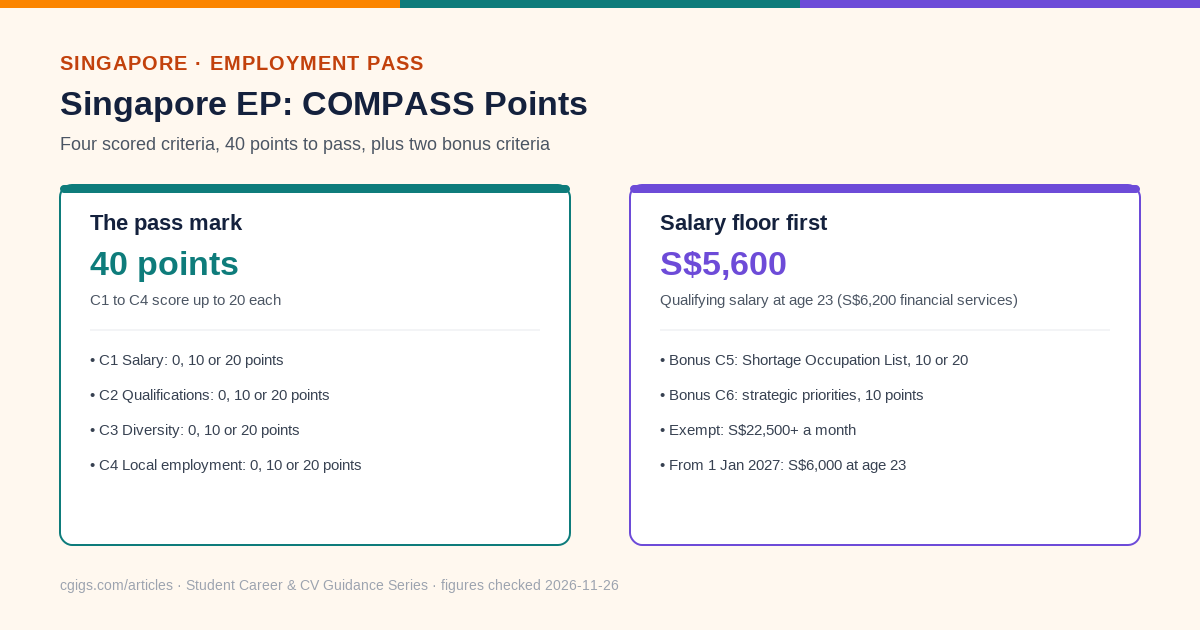
In Singapore, an Employment Pass (EP) is not only about your degree. Your employer's application is scored on a system called COMPASS, and it needs 40 points. Some points are about you. Some are about the company. Here is how it works, with numbers from the Ministry of Manpower (MOM). If you are a student planning to work in Singapore after graduating, it helps to know this before your first interview, not after the offer.
Step 1: the salary floor
COMPASS only starts if you pass the EP qualifying salary. It goes up with age from 23 to 45.
At age 30 the general figure moves from S$7,223 to S$7,750 in 2027, and the financial services figure from S$7,982 to S$8,541. Fail this step and you are out, whatever your COMPASS score. The MOM page was last updated on 3 November 2026 and shows no separate change taking effect during 2026; the next rise is 1 January 2027 for new applications.
Step 2: the four scored criteria, plus two bonuses
PMET means professionals, managers, executives and technicians. A firm with fewer than 25 PMETs gets 10 points by default on C3 and C4. A local PMET share of 70% or more guarantees at least 10 points on C4. A candidate with no degree-equivalent qualification scores 0 on C2 but can still pass with 40 points from the others.
- C5, skills bonus: if the job is on the Shortage Occupation List, 20 points when your nationality is under one third of the firm's PMETs, otherwise 10. You must really do those duties, and if you needed these points to pass you can only work in that occupation unless MOM reassesses you.
- C6, strategic economic priorities: 10 points for taking part in an eligible programme. The supporting agency decides. It lasts up to 3 years or the length of the programme, whichever is shorter.
Some applications skip COMPASS: a fixed monthly salary of S$22,500 or more, overseas intra-company transfers, or a role of one month or less.
C1 in real numbers
MOM publishes a salary table for each sector. Here are two ages from the Professional Services table, released August 2025, for new applications from 1 January 2026 to 31 December 2026:
For comparison, the Manufacturing table at age 24 is S$5,830 for 10 points and S$8,224 for 20 points. Same age, different sector, different bar. MOM has also published new tables for applications from 1 January 2027, so look up your own sector and age.
- Degrees from the top 100 in the QS World University Rankings, and other highly reputed Asian universities.
- Singapore's autonomous universities.
- Institutions highly recognised in a particular field and endorsed by a relevant agency.
The full list is a MOM PDF. It is updated every year, and the new list applies from 1 January 2027.
Worked example: Wei, a fictional graduate
This is an example we made up. Wei is 24, with a bachelor's from a university on MOM's top-tier list, and has a job offer in Professional Services at S$6,500 a month. We assume that clears the EP qualifying salary for age 24. The employer checks that first.
Now change two things. Wei's degree is from a university not on the top-tier list, so C2 drops to 10. The firm is below the 20th percentile on local hiring, so C4 is 0.
Result: C1 10 + C2 10 + C3 10 + C4 0 = 30. That is 10 points short.
A job on the Shortage Occupation List could add bonus points. Another employer might score differently. A candidate cannot change C3 and C4, so a refusal is not always about you.
A 5-minute self-check, and what it means for your CV
You cannot see the firm's C3 and C4 numbers yourself. You can check your own side in a few minutes:
- Step 1: find your age and sector on the EP qualifying salary table. Is the offer above it?
- Step 2: open the C1 benchmark PDF and find your sector and age. Is the offer above the 10-point salary? Above the 20-point salary?
- Step 3: check whether your university is on the top-tier list, and note the exact name MOM uses.
- Step 4: ask the employer to run the Self-Assessment Tool. They have the firm data you do not.
- Step 5: if the answer is close, ask whether a different job title or a different salary could change the score. Do not ask them to change a job title just to get points; the duties must match.
- A good CV can still meet a no. If the firm scores badly on C3 or C4, it may not be able to hire any foreign graduate for that role. This is about the company's numbers, not your effort.
- Ask early. Before an interview round three, ask the recruiter whether the company has sponsored EPs before. It is a normal question.
- Look for fits. Small firms with under 25 PMETs get 10 points on C3 and C4 by default, so they start from 20 of the 40.
- Know your own two. C1 and C2 are the only ones tied to you. A better salary offer or a top-tier degree moves your side of the score.
These lines are examples we made up. Use real numbers from your own work:
Keep the education block near the top and the dates clear. The employer may need to upload your degree proof, so the name, level and year on the CV should match the certificate.
- The candidate's details and job title. The title matters for C5.
- Qualifications and proof only if you need C2 points to pass. Otherwise they should not be submitted.
- The employer must have met the Fair Consideration Framework job advertising rule before a new EP application.
- Employers can check their position first with MOM's Self-Assessment Tool and the Workforce Insights tool on the myMOM Portal.
You cannot control C3 or C4. You can control how clearly your CV shows C2.
- Spell the university name exactly as on your certificate. Verification needs a match.
- Show the degree level and year: BSc, MSc, and the graduation year.
- Put education near the top if you are a recent graduate.
- Do not state a salary expectation as fact. Give a range only when asked.
- Photo: a photo is not needed for this process, and it is a habit rather than a rule. Leave it out unless the employer asks.
Read the job ad, too. Employers must advertise first, so apply early and match your CV to the ad. If you are on the shortlist, keep your degree papers handy: if you need C2 points, the employer will have to upload proof of your qualification, and delays there can slow the whole application. Also keep your graduation year and your exact degree title consistent across your CV, your LinkedIn page and your certificate.
Sources (all checked 2026-11-26): MOM, Eligibility for Employment Pass, https://www.mom.gov.sg/passes-and-permits/employment-pass/eligibility. MOM, COMPASS, https://www.mom.gov.sg/passes-and-permits/employment-pass/upcoming-changes-to-employment-pass-eligibility/complementarity-assessment-framework-compass. MOM, COMPASS C1 salary benchmarks (PDF released Aug 2025), https://www.mom.gov.sg/-/media/mom/documents/work-passes-and-permits/compass/c1-salary-benchmarks.pdf.
Put your degree and skills on one clean page.
Build your CV free