You work shifts at a cafe, a shop or a restaurant. Your CV is for a software, data or IT role. So do you hide the job, or do you list it? Neither. You keep it short and you pick the parts a tech employer cares about.
This guide gives you the data, a size rule, 7 before-and-after bullets and a 10-minute method. All numbers inside the sample bullets are examples. Swap in your own.
Why the job is worth a few lines
Real numbers first:
• Most students work. NCES (Condition of Education, 2020 data) says 40% of full-time undergraduates and 74% of part-time undergraduates were employed. Georgetown University's Center on Education and the Workforce said in 2015 that more than 70% of college students had worked while enrolled over the previous 25 years. So recruiters see this job all the time.
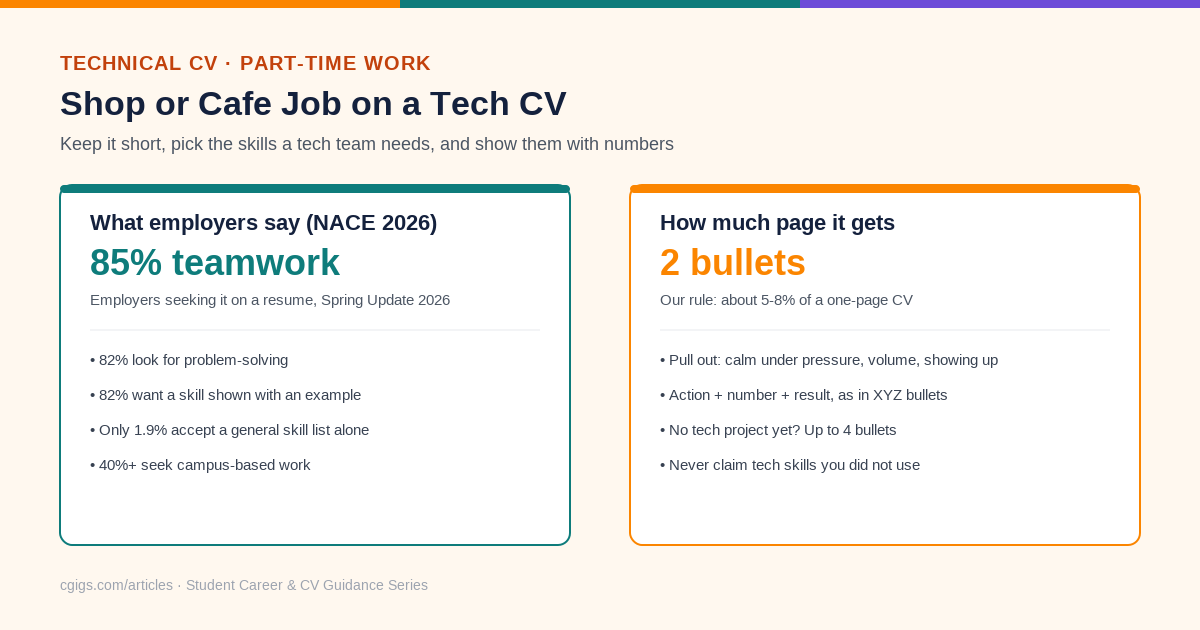
• Employers want the soft skills this job trains. In the NACE Job Outlook 2026 Spring Update (fielded Feb 12 to Mar 17, 2026, 185 employers), 85% said they look for the ability to work in a team on a resume and 82% said problem-solving. Communication, teamwork and critical thinking topped the importance ratings (4.5, 4.5 and 4.4 out of 5).
• They want proof, not a list. In the same survey, 59% preferred specific skills listed with examples and 23% preferred general skills with examples. Only 16.1% were happy with specific skills alone and 1.9% with general skills alone. So 82% want an example (59 + 23).
• Campus work counts. NACE Job Outlook 2026 says more than 40% of employers seek candidates with campus-based work or apprenticeships.
Two cautions. These are employer surveys, so they show what employers say, not what each recruiter does on a given day. And we found no good public study on how recruiters treat a non-relevant part-time job on its own. So we will not invent a number for that.
A size rule: how much page it deserves
This rule is our rule of thumb, not a study. It comes from the fact that a one-page CV has very little room.
A one-page CV at 10 to 11 pt holds roughly 45 to 55 lines of text (our estimate; count your own template). Work it out:
• 50 lines on the page.
• Give the retail or hospitality job about 5 to 8% of them.
• 50 x 0.05 = 2.5 lines. 50 x 0.08 = 4 lines.
• So: 1 header line plus 2 bullets. Three bullets at most.
Rule 2: never let it outrank your tech work. Tech projects go first and get more bullets. Rule 3: if two bullets say the same thing, delete one.
The 3 things to pull out of a service job
Pick from these. They map to what a tech team needs.
• Calm under pressure (de-escalation). An angry customer is a bug report with feelings. You listen, repeat the problem, fix it, check it is fixed. That is also how you handle a stressed user or a failed demo.
• Volume and accuracy (high-volume transactions). A till that balances is a small proof of care with detail. Counts, speeds and error rates show it.
• Showing up (punctuality and reliability). Opening shifts, covering for a sick colleague, no missed shifts. Teams ship on people who turn up.
7 before-and-after bullets
All numbers below are made-up examples. Use only figures you can defend in an interview. Each "after" line has an action, a number and a result, the same shape as in tech resume action verbs and the Google XYZ formula.
What changed:
• Every "before" is a duty. Every "after" is a result.
• Each one points to one skill from the list above.
• None claims a tech skill you did not use. If you built a stock spreadsheet or a booking sheet, say so. If you did not, do not stretch.
A 10-minute method to get your own numbers
Do this once, then reuse it.
• Minute 0-3. Write down your typical shift: hours, how many customers, what you handled.
• Minute 3-6. For each of the 3 skills, find one count: sales per shift, complaints per week, shifts you covered, people trained.
• Minute 6-8. Ask: did something get faster, cheaper or less wrong because of you? Even a small change counts.
• Minute 8-10. Pick the best 2 and write them in action + number + result form. Round down, not up. Say "about" or "around" if you estimated.
If you cannot get a number, state the scale instead: "Closed the cafe alone on weekends" is still better than "worked hard".
Mistakes to avoid
• Listing duties. "Greeted customers" tells nobody anything.
• Soft-skill words with no example. "Excellent communicator" is a claim. A trained-4-hires bullet is a fact.
• Too much space. If it has more lines than your best project, cut it.
• Fake tech. Calling the till system "POS software development" gets caught in the first interview.
• Made-up numbers. Invented figures fall apart when an interviewer asks how you counted. Use real ones.
For how much your whole page should hold, see one-page graduate CV and the recruiter scan time.
Sources (all checked 2026-11-27): NACE, Job Outlook 2026 Spring Update (April 2026), https://www.naceweb.org/job-outlook/ and https://naceweb.org/talent-acquisition/candidate-selection/the-key-skills-employers-seek-on-college-students-resumes (85% teamwork, 82% problem-solving, importance ratings, examples vs lists). NACE, Job Outlook 2026 (Nov 2025), https://naceweb.org/research/reports/job-outlook/2026/ (more than 40% seek campus-based work). NCES, Condition of Education, College Student Employment, https://nces.ed.gov/programs/coe/indicator/ssa/college-student-employment (40% and 74% employed, 2020). Georgetown CEW, Learning While Earning: The New Normal (2015), https://cew.georgetown.edu/workinglearnerspressrelease (more than 70% worked while enrolled). The bullet numbers, the 45 to 55 line estimate and the 5 to 8% rule are examples or our own rule of thumb.
Put your shift work in the right size on a clean one-page layout.
Build your CV free