You find a job you want. You have an hour, or you have ten minutes. Either way you do not want to rewrite your whole CV. And you do not want to paste the job ad into a white-text block either.
This is a 15-minute routine. It has 4 steps. You keep one master CV, and you make a tailored copy for each job. The job ad below is a made-up example, so are the numbers in the sample bullets.
Why keywords matter at all
Most employers use an applicant tracking system (ATS). Recruiters often use it like a search engine. Here is what we could source:
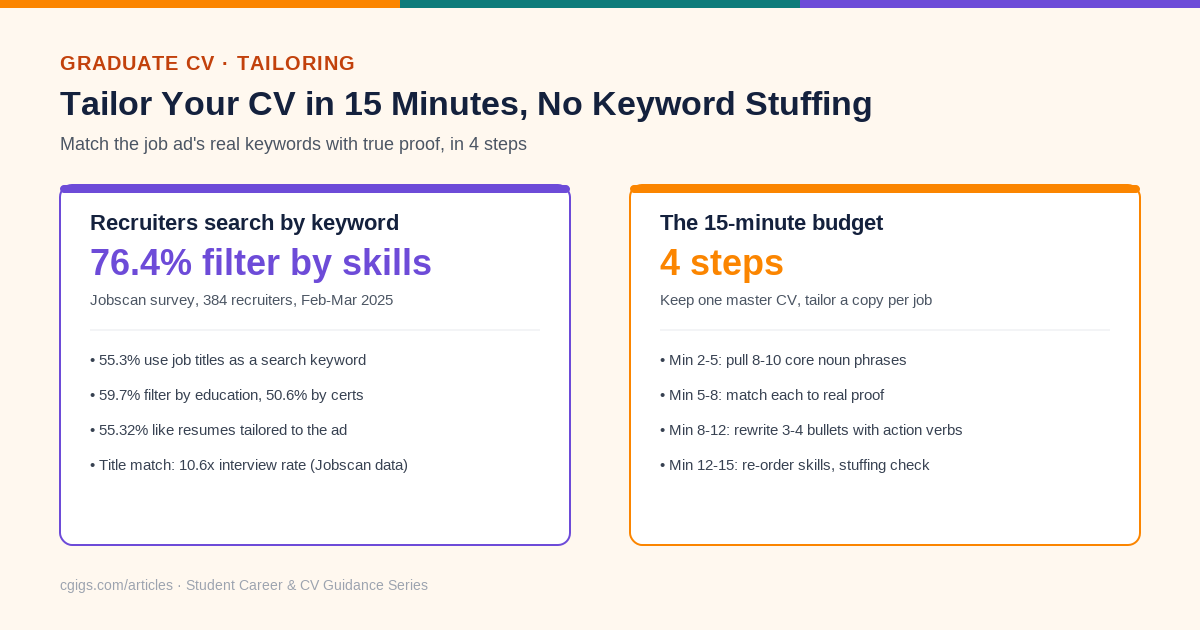
• Jobscan surveyed 384 recruiters in February and March 2025. Over 99.7% said they use filters to find candidates to interview.
• 76.4% start filtering by skills. 55.3% use job titles as a search keyword. 59.7% filter by education and 50.6% by certifications.
• 41% search people already in their ATS from earlier openings.
• 55.32% said they like resumes tailored to the job description.
• In Jobscan's own data on over 2.5 million applications, resumes whose title matched the job title had a 10.6 times higher interview rate.
Two cautions. Jobscan sells resume tools, so read this as one vendor's data, not a law. And the 10.6 figure is about job titles, not about keyword counts in general.
How does the search work in practice? Greenhouse, a common ATS, documents a Full Text Search: a recruiter types terms, and results show a small snippet of where the terms appear in the profile. So a search finds words that are on your page. If the ad says "data visualization" and your CV says nothing like it, you do not show up for that search. If your CV does say it, you show up, and the snippet shows your line.
The 4 steps and the time budget
The example job ad (made up)
Step 1: pull out the core noun phrases (minutes 2-5)
Read the ad and write down the things, not the fluff. Tools, methods, deliverables, and people you work with. Skip "fast-paced", "team player", and "passionate".
Tip: a phrase that shows up in both the duties and the requirements is core. Put a star on it.
That is 8 phrases. Aim for 8 to 10. More than that and you will start stuffing.
Step 2: match phrases to real proof (minutes 5-8)
Open your master CV. For each phrase, find the project, course or job where you really did it. Write the match next to it.
• If you did it: it goes in.
• If you did a little: say it small and true, like "A/B test analysis (course project)".
• If you never did it: leave it out. Do not add a skill you cannot talk about in an interview. They will ask.
Step 3: align verbs and phrases in 3-4 bullets (minutes 8-12)
Pick the 3 or 4 bullets closest to the ad. Rewrite them so the ad's phrase sits inside a real action. Start with a strong verb. If you want a verb list and a formula, see our guide on tech resume action verbs and the Google XYZ formula.
Before (all numbers are examples):
After:
What changed:
• "Worked on" became Cleaned, wrote, built.
• The ad's phrases (Python pandas, SQL queries, Tableau dashboard, sales data) now appear once each, in a sentence that means something.
• A number and an audience were added. Use yours, and only if they are true.
Step 4: re-order skills and top lines (minutes 12-14)
Do not add. Re-order. Put the skills the ad names first, in the ad's words.
Your skills line before:
After, for this ad:
Use the ad's spelling for tools you really know. If the ad says "Tableau", write Tableau. If it says "JavaScript" and you write "JS", a keyword search may miss you. Write the full name, with the short form in brackets if you like. Our technical skills section guide shows how to group them.
If the job title is plain and true for you, you can echo it in your headline, e.g. "Data analytics graduate". Do not claim a job title you have not held.
The stuffing check (minute 14-15)
Keyword stuffing means repeating terms or hiding them (white text, tiny text). It does not help a human reader, and it can look bad if a person opens the file. Run this quick test:
• Does each key phrase appear 1 to 3 times, each time in a real sentence or a skills line?
• Can you tell a story about every skill listed, in 30 seconds?
• Does any phrase appear only in a hidden or tiny block? Delete it.
• Read the top third of page one out loud. Does it sound like a person?
• Save as PDF and name it clearly, like Firstname-Lastname-CV.pdf. Our PDF vs DOCX parse test covers file formats.
What this will not do
• It will not turn a weak match into a strong one. If you have 2 of 8 core phrases, apply anyway if you want to, but expect fewer replies.
• It will not beat a real person's first read. Humans still decide.
• Rejection is not always from a keyword. Jobscan itself describes the ATS as a search tool and says it rarely rejects people automatically, but that is a vendor statement, not an audit.
Save your best tailored copy as a template. Next time, you are 5 minutes in already.
Sources (all checked 2026-11-27): Jobscan, The State of the Job Search in 2025 (recruiter survey, 384 recruiters, Feb-Mar 2025; title-match figure from over 2.5 million applications), https://www.jobscan.co/state-of-the-job-search . Greenhouse Support, Search resumes for keywords (Full Text Search), https://support.greenhouse.io/hc/en-us/articles/115004600186-Search-resumes-for-keywords . The job ad, the student, and all numbers in the sample bullets are made-up examples.
Keep one master CV, then tailor a copy for each job in 15 minutes.
Build your CV free