You got the internship. Good. Now the real job starts: getting a return offer.
You cannot control the company's headcount. You can control what they see in 12 weeks. This is a week-by-week plan with 30-60-90 style goals, a midpoint talk, and a final demo. The plan is practical advice, not a guarantee. The numbers below come from NACE, and the plan itself is our suggestion.
The odds: what NACE actually reports
NACE (the US National Association of Colleges and Employers) surveys employers and students every year. These are the figures we checked:
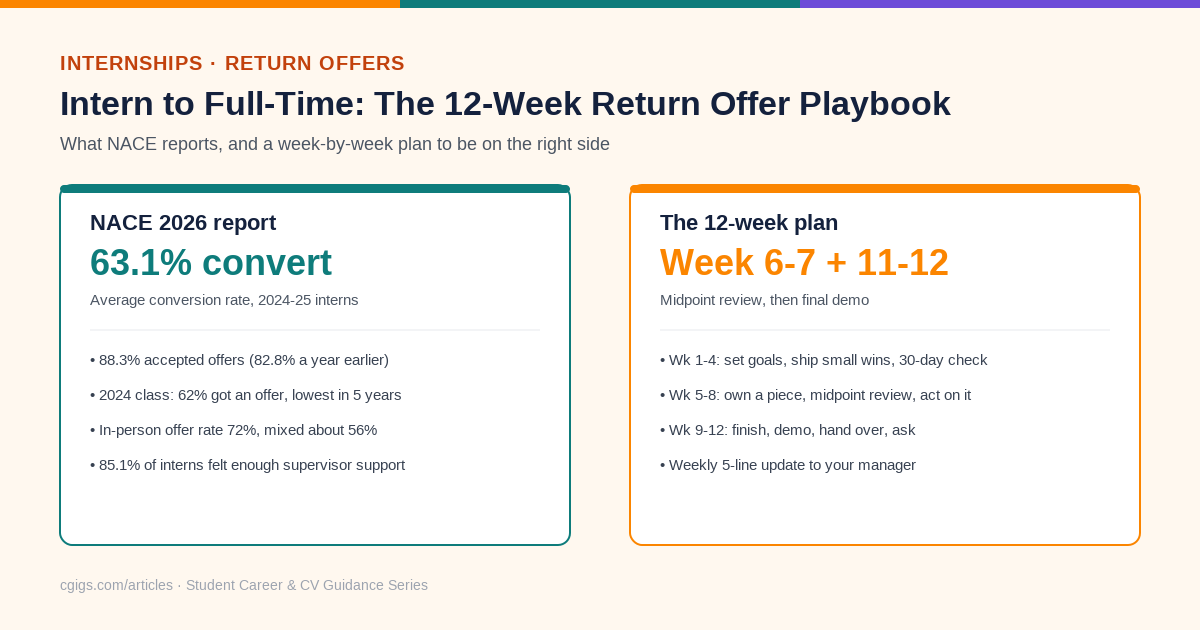
• 63.1% average intern conversion rate for 2024-25 interns, up nearly 13% from 2023-24 (2026 Internship & Co-op Report, published 3 April 2026).
• 88.3% of interns accepted an offer in 2024-25, up from 82.8% the year before.
• 62% of the 2024 intern class got a full-time offer, vs two-thirds of the 2023 class. That was the lowest offer rate in five years at the time (2025 report, 11 August 2025).
• In-person internships averaged a 72% offer rate. Mixed remote and in-person ones averaged about 56%.
• From the student side (Class of 2024): 53.3% of interns intended to convert, 85.1% said they had enough supervisory support, and 79.9% were satisfied.
These are US employer surveys. The 2026 survey had 284 organizations, and the 2025 one had 247. They are not every company. Our piece on what an intern costs a small team uses the same 63.1% figure from the 2026 report, so the two articles agree.
A quick worked example
Takeaway: around 6 in 10 is normal. Being in the room more often (in person, where you can) seems to help. NACE reports the pattern, but not the reason. Do not read cause into it.
Before day 1: ask 3 questions
• "What would a successful summer look like to you?"
• "Who decides on return offers, and when?"
• "How will I get feedback?"
Write the answers down. They become your scorecard.
The 12-week table
30-60-90 in an internship
A 12-week program is about 84 days, so the classic split is roughly:
• Day 1-30: learn and earn trust. Ship small things on time. Ask good questions. Do not ask the same one twice, write the answer down.
• Day 31-60: own something. One real piece of the project, with your name on it. Tell your manager how it's going before they ask.
• Day 61-84: show it and hand it over. Finish, demo, document. Someone else must be able to continue your work.
Get a manager champion
A champion is someone senior enough to speak for you when the headcount talk happens, and who knows your work. Often that is your manager. Sometimes it is a team lead.
• Send a short weekly update: done, doing next, blocked. Five lines.
• Make their life easier. Take notes in meetings. Finish what you start.
• Ask for their view: "What would make you want to hire me?" Once, honestly, around week 6.
• Be easy to work with. NACE's student data shows 85.1% of interns felt they had enough supervisory support. If you are in the other 14.9%, ask for a regular 1 on 1 slot. A fixed 20 minutes a week is enough.
The midpoint review (week 6-7)
Ask for it. Do not wait to be given one. Bring one page:
Then listen. Do not defend. Write down the answers and email a short thank-you with the 2 or 3 changes you will make. In week 8, do them and say so.
The last question is the important one. If the answer is "headcount is frozen", you will know, and you can plan: ask for a reference and a LinkedIn recommendation, and start applying elsewhere.
The final demo (week 11-12)
Invite your manager, the manager's boss if possible, and the people who helped you. Thank them by name. Send the slides after.
The ask
In week 11 or 12, ask directly and politely: "I have enjoyed this summer and would like to join full time. What are the next steps?" Then:
• Ask about timing, and about the offer deadline.
• If there is no offer yet, ask when you will hear.
• Get personal email and LinkedIn contacts before you leave.
• Update your CV with what you built. Use real numbers. See our guide to action verbs and results bullets.
If no offer comes
• It is not always about you. NACE saw offer rates fall in the 2025 report even as students were accepting more.
• Ask for feedback, a reference and an introduction.
• You still have 12 weeks of proof for your next application.
Sources (all checked 2026-11-27): NACE, "Intern conversion rate hits highest mark in five years" (Kevin Gray, 3 April 2026; 2026 Internship & Co-op Survey, 284 organizations, fielded 15 Oct 2025 to 4 Jan 2026), https://naceweb.org/talent-acquisition/internships/intern-conversion-rate-hits-highest-mark-in-five-years . NACE, "Intern offer and conversion rates fall, acceptances rise" (Mimi Collins, 11 August 2025; 247 organizations), https://naceweb.org/talent-acquisition/internships/intern-offer-and-conversion-rates-fall-acceptances-rise . NACE, "Key Factors Leading to Intern Conversion" (Kevin Gray, 13 January 2025; 2024 Student Survey, 2,281 graduating seniors), https://naceweb.org/talent-acquisition/internships/key-factors-leading-to-intern-conversion . The 12-week plan, the page templates and the 10-intern sum are our own suggestions and examples, not NACE findings. NACE reports no data on midpoint reviews or demos.
Got the internship? Build a CV that shows the work you will do there.
Build your CV free