A hackathon gives you 24 to 48 hours and a rough prototype. A CV gives you one or two lines. The job is to turn one into the other without lying and without wasting the line.
This guide shows how. You get three bad vs good entries, the exact commands to get real numbers, and a link checklist so your project still opens in 2027.
What a recruiter needs from one project entry
A reader gives each project a few seconds. So each entry has to answer five things fast:
- What is it? One plain phrase, not a buzzword.
- What did you build? Your part, not the team's.
- How is it built? The stack and the shape, in one line.
- Can I see it? A live link and a code link that work.
- What proves it? One number you measured, or one result you can point to.
If an entry has all five, it beats a long paragraph. If it has none, it is just a hackathon name drop.
Three entries: bad vs good
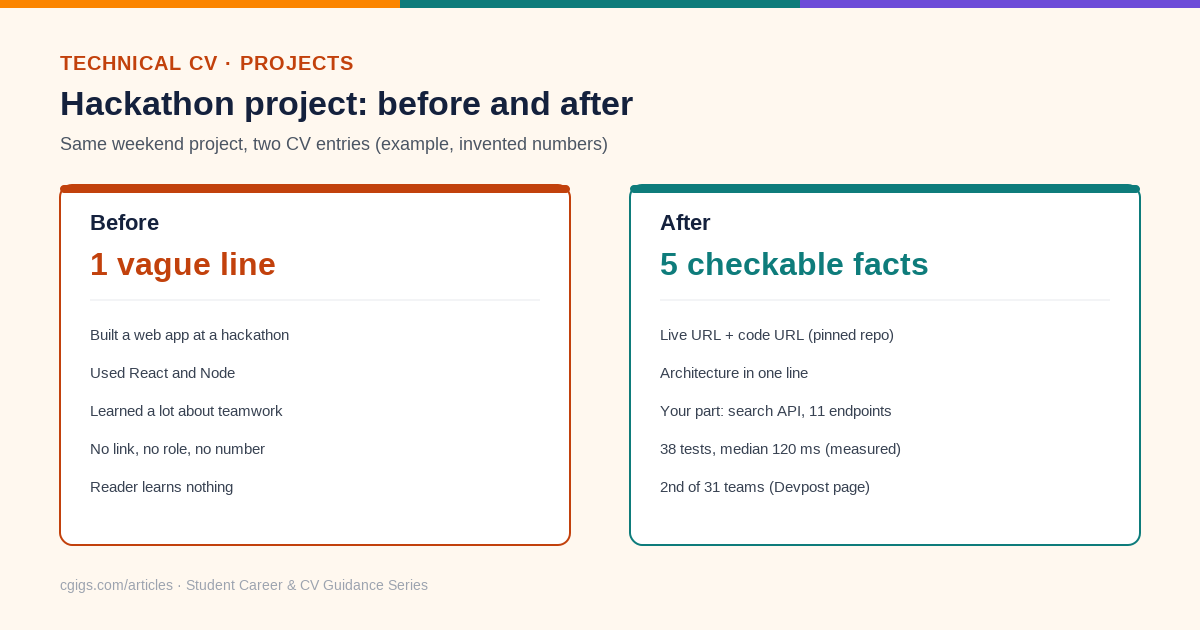
The projects below are made-up examples for illustration. Names, links and numbers are invented. Swap in your own real ones.
What changed: a live URL, a code URL, the architecture in one clause, your own role, and two numbers you can check. "Learned a lot" is gone.
"Won best project" with no event, no field size and no source reads as a stretch. A named prize with its track is checkable. If you are not sure of a number, leave it out.
Put the project first and the placing last. A prize without a product makes people ask what the project even does.
The pieces, one by one
1. The live URL
A working demo is the strongest proof. Rules:
- Put it on the line right under the project title.
- Open it in a private window before every application. If it is down, fix it or remove it.
- If there is no hosted version, link a 2 to 3 minute demo video instead. Devpost's sample project template suggests a demo of about 3 minutes and a link to try the project where possible (see Sources).
- Do not link a login wall with no test account.
2. The architecture in one line
Format: what talks to what. Short is better.
- "React front end, FastAPI service, PostgreSQL database, deployed on one small VM."
- "Discord bot in Python, reads Google Calendar, stores nothing."
Skip logos and lists of 14 tools. Name only what you actually wrote code in. Match the names to your skills section; our technical skills section guide shows how to keep them in sync.
3. Your own role
Hackathon work is team work, so say which part is yours. Good phrases:
- "Built the ... API"
- "Wrote the ... parser"
- "Set up deploy and CI"
If you did a bit of everything, say what the biggest piece was. Do not claim the whole product.
4. Numbers you can really measure
Weekend projects rarely have users. They do have numbers. Get them from the tools, not from memory:
Rules for numbers:
- Write the count you saw, with the unit. "38 tests", "120 ms median over 20 runs".
- Say how you measured it in your README, so you can explain it in an interview.
- Commit counts show effort, not quality. Use them as a split of work ("61 of 112 commits"), not as a boast.
- No users? Do not invent users. "Tested with 6 classmates" is fine if you did it.
5. The award line
Write awards so a stranger can check them:
- Placing + field size + event. "2nd of 31 teams, Example Hack 2026." Only if the organizers published the number of teams.
- Sponsor or track prizes. Name the prize: "Best Use of Public Data (sponsor track)."
- Finalist / demo-stage. If you were in the top 10 of 60, say that.
- No prize? Leave the line out. A built and deployed project already stands without one.
"1st of N teams" goes on your CV only if it is true and you can show where it says so. Devpost project and winners pages are good places to point to. Anyone can check, and one wrong line makes a reader doubt the rest.
Rule of thumb: Projects for things you built, Experience for things you ran. Do not put a weekend event under Experience as if it were a job. Keep to 2 or 3 projects total; our one page graduate CV guide covers how to fit them.
What to leave out
- Soft-skill filler: "learned a lot", "worked under pressure".
- Every tool in the stack, if you wrote code in only half.
- Team-mates' parts described as yours.
- Prize money, unless asked.
- Repos with API keys in the history. Search your commit history for keys before sharing, and rotate any key that ever appeared.
- Anything that no longer runs and has no video.
Link hygiene: will it still work in 2027?
Your CV is read months after you wrote it. Check these before you send:
- Pin the repo. GitHub lets you pin up to six repositories and gists combined to your profile. Pin your best two or three projects.
- Write a README. GitHub says a README should explain what the project does, why it is useful, how to get started, where to get help and who maintains it. Add a screenshot and the live link.
- Tag a release. Make a tag like v1.0-hackathon so the version you showed is frozen, even if you keep changing the code.
- Use a short link you control for the demo, if the real URL is long or may move. Then you change one redirect, not every CV.
- Record a demo video. Free hosting can be switched off; a video link survives.
- Test in a private window, on your phone too. Do it before each application round.
- Put your Devpost page link in the README, so award claims can be checked from one place.
Keywords that help (without stuffing)
Applicant systems and recruiters search for words like these. Use only the ones that are true for you, in plain sentences:
- hackathon project resume
- devpost GitHub CV
- student hackathon award bullet point
- portfolio links
A natural line such as "Built and deployed ... (Devpost, GitHub)" covers them. For stronger bullet wording, see our action verbs and XYZ formula guide.
Next step: code in projects that are not yours
Once a project is solid, the next credibility step is merged code in someone else's repo. Our companion guide covers it: open source contributions on a junior developer CV.
Quick checklist
- Live link works in a private window
- Code link points to a pinned repo with a README
- One line of architecture
- Your role in one clause
- Two numbers you measured, with units
- Award line only if true and checkable
- Under 4 bullets per project
Sources (all checked 2026-11-26): GitHub Docs, About READMEs, https://docs.github.com/en/repositories/managing-your-repositorys-settings-and-features/customizing-your-repository/about-readmes (checked 2026-11-26). GitHub Docs, Pinning items to your profile, https://docs.github.com/en/account-and-profile/setting-up-and-managing-your-github-profile/customizing-your-profile/pinning-items-to-your-profile (checked 2026-11-26). Devpost, sample project template (a VTHacks 8 page, not official Devpost docs), https://devpost.com/software/xrdc (checked 2026-11-26). The three projects above are invented examples, not real events or results.
Turn your hackathon project into a clean one-page CV entry in minutes.
Build your CV free