You want to know what a real job in your field looks like. An alum works at a company you like. A 15-minute chat is the easy way in. Most students freeze at the same point: what do I actually say?
This guide gives you a minute-by-minute script, a short request message, a thank-you note and the data on why these chats pay off. The names in the examples are made up.
Why bother: what the numbers say
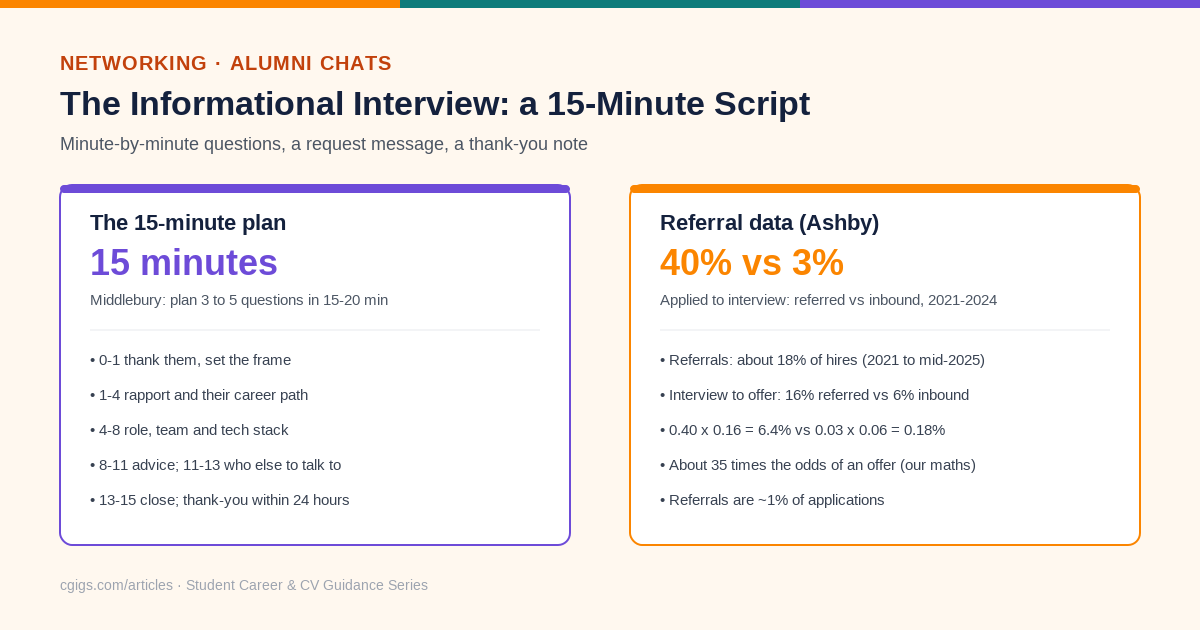
Referred candidates do better in hiring funnels. Here is what we could find, with the source and the dates. None of it is about students only. It covers all hires at the companies in each dataset, so read it as a hint.
A worked example from the Ashby stage rates. This is our multiplication, not a figure the report states:
• Referred: 0.40 x 0.16 = 6.4% of applicants get an offer.
• Inbound: 0.03 x 0.06 = 0.18% get an offer.
• 6.4 / 0.18 is about 35 times the odds.
Two cautions. These are offers, not hires. And a "referral" in these systems usually means an employee submitted you, which is more than a chat. The chat is how you get to a point where that can happen.
Student-only data? NACE runs surveys on how students search for jobs, but the channel-by-channel numbers sit in member-only reports. We could not check them, so we do not quote any.
What career centers tell you to do
These are the rules the career offices at Georgetown and Middlebury agree on:
• Aim to learn, not to get a job. Georgetown: run these chats "with the goal of learning, not simply getting a job offer."
• Keep it short. Middlebury describes a 15-20 minute conversation, with room for about 3 to 5 questions.
• Send a thank-you within 24 hours and mention something specific you learned (Middlebury).
• Ask who else to talk to. Middlebury notes a referral to another professional can be worth more than a single job lead.
• Write the person's details down: name, title, date, topics (Georgetown).
Step 1: the request message
Send it on LinkedIn or by email. Say where you found them, who you are, what you ask, and how little time it takes. Give them an easy out. The names below are made up.
Why it works:
• One clear detail from their profile shows you did your homework.
• The ask has a size (15 minutes) and a choice (call or chat).
• It does not mention jobs. You are asking for their story.
Prepare before you book. Read their LinkedIn, the company's engineering page and one recent project or post. Write down 6 questions and expect to use about 5.
Step 2: the 15-minute script
Minutes 1 to 4: rapport and trajectory. Start with the shared ground, your school. Then ask how they got here. People like telling their own story. Good follow-ups:
• "How sure were you about this path at my stage?"
• "What would you do differently in your first year?"
• "Was the first job what you expected?"
Minutes 4 to 8: the role, the team and the stack. This is the part you cannot find online. Ask:
• "What is a typical day like?"
• "What tools and languages does your team use?" (Then listen. Note the names for your next project.)
• "What is the hardest part of the job right now?"
• "How does the team work with other teams?"
Do not ask things you could read on their website. Spend the time on opinions and stories.
Minutes 8 to 11: advice. Ask what they wish someone had told them before starting. Ask what makes a strong entry-level candidate on their team. Take notes. Say one of their points back so they know you heard it.
Minutes 11 to 13: the referral question, gracefully. Do not say "can you get me an interview?" at minute 11. You put them on the spot, and they may not be able to. Do this instead:
• First ask: "Who else would you suggest I talk to?" This is almost always easy to answer.
• If a role at their company comes up on its own, ask: "Would it be okay if I sent you my CV in case something fits?"
• Never ask for a referral in your first message.
• If they say no, say "Thanks, that's really helpful" and move on.
Many companies pay employees a bonus for referrals, but the rules differ from company to company. Do not assume. Let them tell you what they are comfortable with.
Minutes 13 to 15: the close. Stop on time even if the chat is going well. Say what you will do next ("I'll try the Docker tutorial you mentioned"). Ask if you can send an update in a month. Thank them.
Step 3: the thank-you note
Send it the same day, and no later than 24 hours. Name one specific thing. Attach your one-page CV only if they asked.
Then set a reminder. In 4 to 6 weeks, send a two-line update: what you built, what you tried from the chat. This is how a one-off chat becomes a contact.
Common mistakes
• Asking for a job in minute one. It breaks the trust.
• No questions prepared. Carnegie Mellon's guide says it is your job to lead the talk and bring the questions.
• Running over time. If you promised 15 minutes, stop at 15.
• Skipping the thank-you. It is the most-forgotten step.
• Never following up. One update message is enough.
• Writing a long first message. If it cannot be read in 20 seconds, cut it.
Next steps: sharpen the profile they will check first with LinkedIn headlines for students. Then have your project bullets ready with action verbs and the Google XYZ formula. If the chat leads you to someone you have not met, read the 75-word cold message template for internships.
Sources (all checked 2026-11-27): Ashby, Talent Trends Report, Inbound (data to June 2025), https://www.ashbyhq.com/talent-trends-report/reports/inbound. Ashby, Talent Trends Report, Referrals (May 2025, data 2021-2024), https://www.ashbyhq.com/talent-trends-report/reports/referrals. SHRM, Employee Referrals Remain Top Source of Hires (SilkRoad Sources of Hire, 2017), https://www.shrm.org/topics-tools/news/talent-acquisition/employee-referrals-remain-top-source-hires. Georgetown Cawley Career Center, Informational Interviews, https://careercenter.georgetown.edu/career-exploration/networking/informational-interviews. Middlebury Center for Careers and Internships, How to Make the Most of an Alumni Informational Interview, https://www.middlebury.edu/center-careers-and-internships/how-make-most-alumni-informational-interview. Carnegie Mellon Career and Professional Development, Informational Interview Guide, https://www.cmu.edu/career/faculty-and-staff/documents-for-career-champions/informational-interview-guide.pdf. The people, company and messages are made-up examples; the 35x figure is our own multiplication of Ashby's stage rates.
Chat booked? Get your one-page CV ready before you hit send.
Build your CV free