"Organized events." Two words, no proof. Half the club presidents on campus wrote the same line. Compare it with: "Managed a $4,000 sponsorship budget and grew membership by 42%." Same job. The second one tells a recruiter how big it was.
This guide gives you a 5-part metrics checklist, 9 before-and-after bullets, a 20-minute way to dig the numbers out, and what to do when your club is small. Every number in the sample bullets is an example. Use your own.
What the data says about leadership on a CV
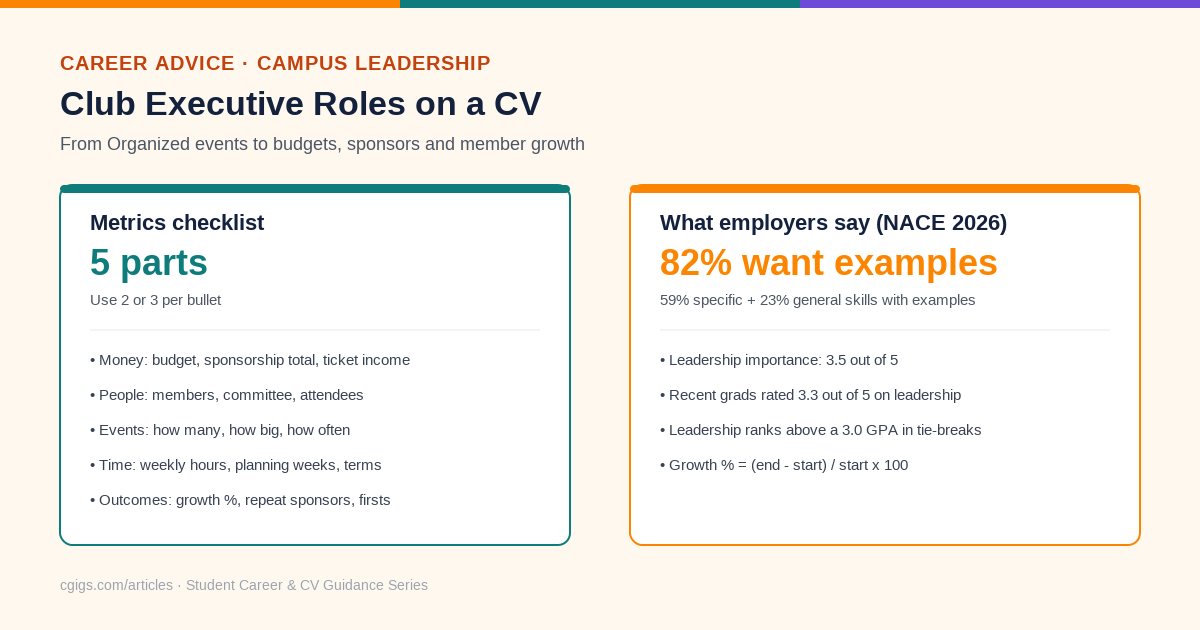
• Leadership counts. NACE's Job Outlook 2026 says that, when choosing between equally qualified candidates, a GPA of 3.0 or higher ranks lower than general work experience, leadership positions and extracurricular involvement. Internships rank highest.
• It is rated important, not top. In the NACE Job Outlook 2026 Spring Update (Feb 12 to Mar 17, 2026), employers rated leadership 3.5 out of 5 for importance. Teamwork and communication got 4.5. So lead with teamwork results inside your leadership bullets.
• Graduates are rated weak on it. Employers gave recent grads 3.3 out of 5 on leadership proficiency. Only AI skills (3.1) scored lower. A proven example stands out.
• They want examples. 59% preferred specific skills with examples and 23% general skills with examples. Only 1.9% were fine with a general skill list alone.
• NACE's own definition: leadership means to "recognize and capitalize on personal and team strengths to achieve organizational goals." Goals, so outcomes and numbers.
Caution: these are surveys of employers (about 150 to 185 respondents each). They tell you what employers say. They do not prove a recruiter will pick you for one line.
The 5-part metrics checklist
Aim for 2 or 3 parts per bullet, not all 5. One strong number plus its result beats five thin ones. The shape is the same as in tech resume action verbs and the Google XYZ formula: do X, measured by Y, by doing Z.
9 before-and-after bullets
All numbers are made-up examples.
Why these work:
• Each starts with a verb and ends with a result or a size.
• Money, people and outcomes show up in most of them.
• Bullets 5, 8 and 9 show a method, which is what teamwork and leadership look like in practice.
• Rounded numbers are fine if they are honest. Say "about" for estimates.
A 20-minute fact-gathering procedure
Do it before you write a single bullet. Set a timer.
• Minutes 0-5: money. Open the treasurer's report or the club's bank/budget sheet. Note the total budget, sponsorship income, ticket income and what was left over. No access? Ask the current treasurer or your student union office.
• Minutes 5-10: people. Open the membership list. Count members at the start and end of your term. Growth % = (end - start) / start x 100. Example: (85 - 60) / 60 = 0.4167, so 42%. Also note committee size.
• Minutes 10-15: events. Open sign-up pages or event forms. Count events, sign-ups, and how many people actually came. Turnout % = attended / signed up. Example: 96 / 120 = 80%.
• Minutes 15-18: time and outcomes. Dates of first and last event, weekly hours, anything that was new on your watch: a new sponsor, a new format, a first-ever event.
• Minutes 18-20: pick 3. Write the 3 biggest numbers on one line each. Those become your bullets.
Save screenshots or exports of the numbers in one folder. If an interviewer asks "how do you know?", you can answer in one breath.
When your numbers are small
A club of 12 with a $200 budget is still a real job. Do this:
• Use the ratio, not the size. "Doubled attendance from 8 to 16" is true and clear. Show the starting number so nobody thinks it is inflated.
• Use the scope. "Ran weekly sessions for 10 weeks" shows consistency even if each had 6 people.
• Use firsts. "Set up the club's first sponsor deal" and "started the club's first website" are facts.
• Use your role in the process. Who did you coordinate, what did you decide, what did you hand over?
• Do not pad. Say 18 members, not "a large community". A small true number is better than a vague big claim.
Where it goes on the page
• Put it under a heading like "Leadership" or inside Experience if it was a big role.
• 2 to 3 bullets per role. One role with 3 strong bullets beats three roles with one dull line each.
• For a technical CV, keep project work above it. If your club work was technical (running the hackathon platform, building the club site), say so, and read how to write a capstone entry with scope, ownership and outcome.
• If the club bullets and your project bullets all start with the same verb, change some.
Sources (all checked 2026-11-27): NACE, Internship Experience Often the Deciding Factor Between Equal Candidates (Job Outlook 2026, data collected Aug 7 to Sep 22, 2025, 183 employers), https://naceweb.org/talent-acquisition/candidate-selection/internship-experience-often-the-deciding-factor-between-equal-candidates (leadership and extracurriculars rank above a 3.0 GPA). NACE, Job Outlook 2026 Spring Update (April 2026, fielded Feb 12 to Mar 17, 2026), https://www.naceweb.org/job-outlook/ and https://naceweb.org/talent-acquisition/candidate-selection/the-key-skills-employers-seek-on-college-students-resumes (leadership importance 3.5/5, proficiency 3.3/5, skills with examples 59% and 23%). NACE Career Readiness Competencies, https://www.naceweb.org/career-readiness/competencies/career-readiness-defined/ (leadership definition). All club names, budgets, sponsorship amounts, member counts and attendee numbers in the sample bullets are made-up examples.
Turn your club role into 3 strong bullets on a clean CV.
Build your CV free